
Question
A 16 year old girl has had three lateral patellar dislocations. She has generalised laxity and a positive apprehension test.
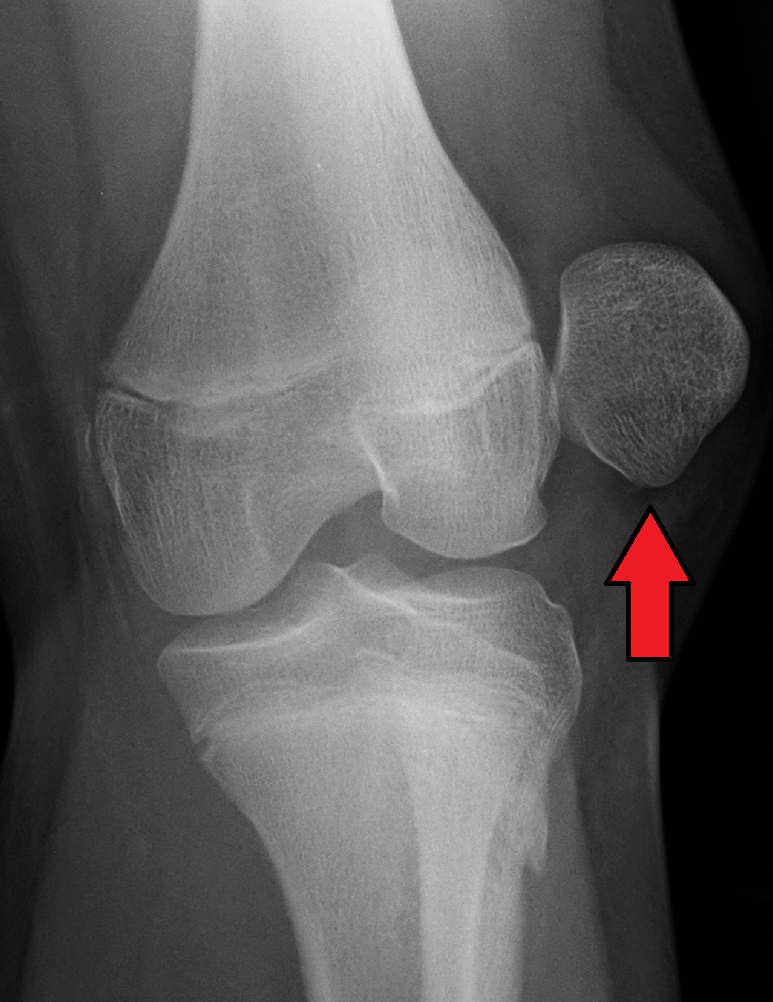
- What are the risk factors for recurrent patellar instability?
- What imaging and measurements would you request?
- Outline your surgical options.
Answer
Risk factors
- Trochlear dysplasia, the most important
- Patella alta
- Increased tibial tubercle to trochlear groove (TT-TG) distance
- Excess femoral anteversion, external tibial torsion and genu valgum
- Generalised ligamentous laxity
- Young age at first dislocation and a previous contralateral dislocation
Imaging and measurements
- Lateral radiograph for patella alta (Caton-Deschamps or Insall-Salvati index) and the crossing sign of trochlear dysplasia
- Dejour classification of trochlear dysplasia A to D
- CT or MRI for TT-TG distance, with over 20 mm abnormal
- MRI for MPFL injury, osteochondral fractures and loose bodies
Surgical options
- MPFL reconstruction with tendon graft for recurrent instability, with care to avoid overtensioning
- Tibial tubercle osteotomy, medialisation for raised TT-TG and distalisation for patella alta
- Trochleoplasty for high grade trochlear dysplasia in experienced hands
- Guided growth for genu valgum in skeletally immature patients
- Repair or fix osteochondral fragments after acute dislocation
Related pages
Author Contributions
Orthofracs team
Reviewed by Professor Phong Tran, Head of Orthopaedic Surgery, Western Health. Last updated 10 October 2026.