
Question
A 74 year old woman has her second dislocation of a total hip arthroplasty performed 4 months ago through a posterior approach.
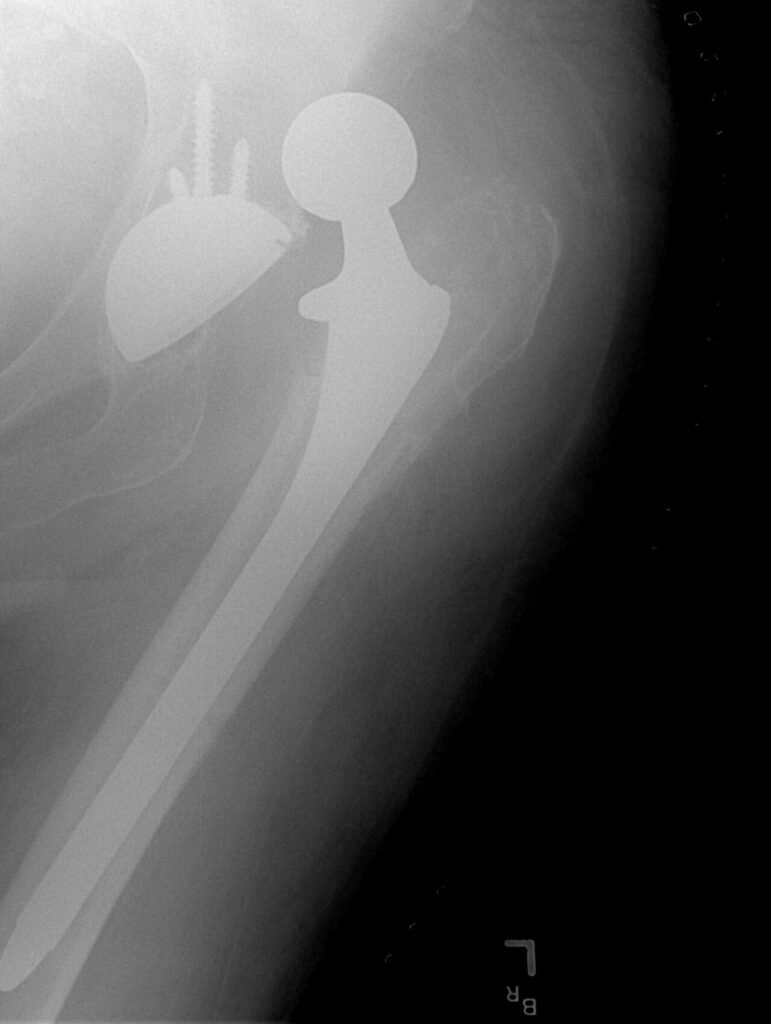
- What are the causes of instability after hip replacement?
- How would you assess her?
- Outline your management.
Answer
Causes
- Patient factors, including age, female sex, neuromuscular disease, cognitive impairment, alcohol and spinal fusion with a stiff spine
- Component malposition, with cup version and inclination outside the target zone or a retroverted stem
- Soft tissue tension, with reduced offset or leg length
- Impingement of bone or components
- Abductor deficiency or trochanteric nonunion
- Late dislocation from polyethylene wear
Assessment
- Mechanism and direction of dislocation and timing
- Radiographs, and CT for cup and stem version
- Inflammatory markers and aspiration to exclude infection
- Assess abductor function and spinopelvic mobility
Management
- Closed reduction under anaesthesia and examination of stability
- A first early dislocation with well placed components is often managed non-operatively with precautions
- Revision for recurrent dislocation, addressing the cause
- Correct malpositioned components, restore offset and length, remove impingement
- Dual mobility or constrained liners for abductor deficiency or high risk patients
Related pages
Author Contributions
Orthofracs team
Reviewed by Professor Phong Tran, Head of Orthopaedic Surgery, Western Health. Last updated 10 October 2026.