
Question
A 45 year old woman with untreated developmental dysplasia of the hip has severe hip pain and a 4 cm leg length discrepancy. Her femoral head sits above the true acetabulum.
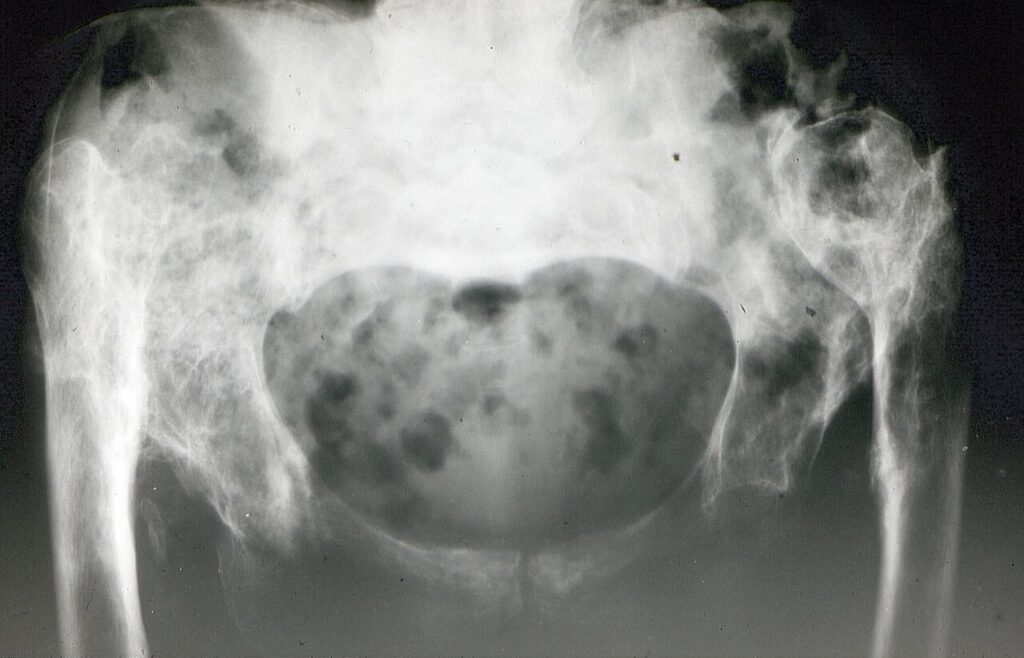
- How is the dysplasia classified?
- What are the technical challenges of hip replacement?
- How would you manage these challenges?
Answer
Classification
- Crowe classification by proximal migration of the head, I under 50%, II 50 to 75%, III 75 to 100%, IV over 100%
- Hartofilakidis classification of dysplasia, low dislocation and high dislocation
Technical challenges
- Shallow, anteverted acetabulum with a deficient superolateral wall and thin medial wall
- Narrow femoral canal with excessive anteversion and posterior greater trochanter
- Leg length discrepancy and contracted soft tissues
- Risk of sciatic nerve palsy when lengthening more than about 4 cm
Management
- Restore the true hip centre with a small cup placed medially
- Structural femoral head autograft or augments for superolateral deficiency
- Modular or straight tapered stems to control anteversion
- Subtrochanteric shortening osteotomy for Crowe IV hips
- Monitor the sciatic nerve and limit lengthening
Related pages
Author Contributions
Orthofracs team
Reviewed by Professor Phong Tran, Head of Orthopaedic Surgery, Western Health. Last updated 10 October 2026.