
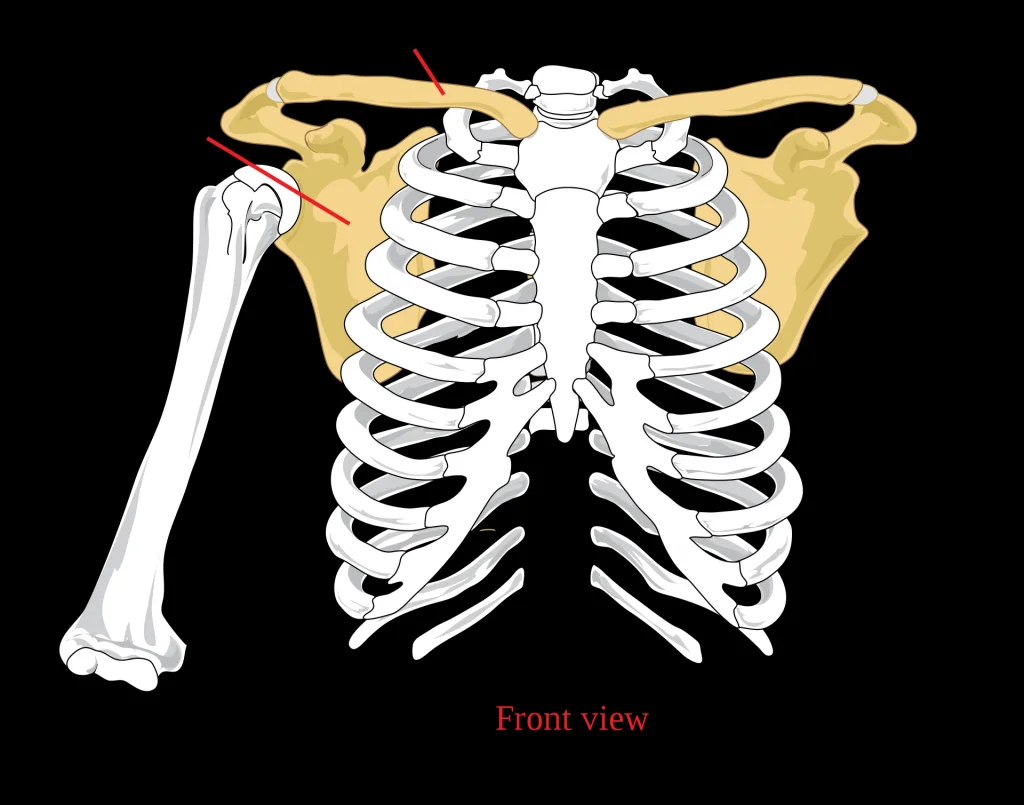
- Pectoral girdle connects the upper limb to the axial skeleton
- Consists of the clavicle and the scapula
- Two joints – sternoclavicular and acromioclavicular
- Strong coracoclavicular ligaments attach the clavicle to the scapula
Movements
- Movement of the glenohumeral joint is accompanied by movement of the clavicle and scapula
- Glenohumeral joint: flexion / extension, adduction / abduction, rotation
- Clavicle: moves in both horizontal and coronal planes, passive rotation around the sternoclavicular joint
Muscles
- Pectoralis Major
- Two heads, sternal (C7, C8, T1) and clavicular (C5, C6)
- Forms the anterior axillary wall
- Origin: Sternal half of clavicle, sternum to 7th rib, cartilages of true ribs (upper 6), aponeurosis of external abdominal oblique muscle
- Insertion: Lateral lip of the intertubercular sulcus of the humerus
- Primary Action: Flexes, adducts and medially rotates the arm
- Innervation: Medial and lateral pectoral nerves
- Pectoralis Minor
- Deep to pectoralis major
- Delineates cords of the brachial plexus and parts of the axillary artery
- Origin: Outer surface of upper margin of ribs 3-5
- Insertion: Coracoid process of scapula
- Primary Action: Lowers lateral angle of scapula and protracts the scapula
- Innervation: Medial pectoral nerve
- Subclavius
- Origin: Costochondral junction of the 1st rib
- Insertion: Subclavian groove on the inferior surface of the clavicle
- Primary Action: Assists in stabilising the clavicle
- Innervation: Nerve to subclavius (C5, C6)
- Trapezius
- Assists shoulder abduction by rotating the scapula
- Origin: Superior nuchal line, external occipital protuberance, nuchal ligament, spinous processes of C7-T12
- Insertion: Lateral third of the clavicle, acromion, spine of scapula
- Primary Action: Elevates, retracts and rotates scapula, lower fibres depress scapula
- Innervation: Spinal part of the accessory nerve CNXI (C1-C5 or C6)
- Latissimus Dorsi
- Forms lower border of the posterior axillary fold
- Origin: Spinous processes of T7-L5, thoracolumbar fascia, iliac crest, and last three ribs
- Insertion: Floor of the intertubercular sulcus of humerus
- Primary Action: Extends, adducts, and medially rotates humerus
- Innervation: Thoracodorsal nerve (C6, C7, C8 – posterior cord of the brachial plexus)
- Rhomboid Major
- Origin: Spinous processes of T2 – T5
- Insertion: Medial border of scapulabelow base of spine of scapula
- Primary Action: Retracts and rotates scapula to depress glenoid cavity
- Innervation: Dorsal scapular nerve
- Rhomboid Minor:
- Origin: Nuchal ligament, spines of C7 and T1 vertebrae
- Insertion: Medial border of scapula at spine of scapula
- Primary Action: Retracts and rotates scapula to depress glenoid cavity
- Innervation: Dorsal scapular nerve
- Levator Scapulae
- Origin: Posterior tubercles of transverse processes of C1-C4
- Insertion: Medial border of scapula from superior angle to spine
- Primary Action: Elevates scapula medially and inferiorly rotates glenoid fossa
- Innervation: Anterior rami of C3-C4 and dorsal scapular nerve
- Serratus Anterior
- Origin: Lateral surface of upper 8-9 ribs
- Insertion: Costal surface of medial border of scapula
- Primary Action: Protracts and rotates scapula
- Innervation: Long thoracic nerve
Joints
- Acromioclavicular Joint
- Sternoclavicular Joint
References
Last, R. and McMinn, R., 1994. Last’s Anatomy. 9th ed. Edinburgh: Churchill Livingstone.
Netter, F., 2018. Atlas Of Human Anatomy. 7th ed. Elsevier.
Author Contributions
Phoebe Walker
Reviewed by Professor Phong Tran, Head of Orthopaedic Surgery, Western Health. Last updated 10 October 2026.