
Overview
- Persisting DDH causes abnormal loading and early arthritis
- Spectrum from mild dysplasia with labral overload to high dislocation with a false acetabulum
- Crowe and Hartofilakidis describe subluxation
- Lateral centre edge angle under 20° and a high Tönnis angle
- Periacetabular osteotomy for young patients without significant arthritis
- THR is demanding, with shallow acetabulum, excess femoral anteversion and shortening
- May need shortening osteotomy or augmentation
Reviewed by Dr Marc Friso MBBS | Unaccredited Orthopaedic Registrar
Pathology
- Shallow, anteverted acetabulum deficient anterolaterally, with a hypertrophic labrum prone to tearing
- Femur has excess anteversion, valgus neck, small head and narrow straight canal
- High dislocation shortens the abductors, hamstrings and sciatic nerve
Classification
Crowe
| Type | Subluxation |
|---|---|
| I | Under 50% |
| II | 50 to 75% |
| III | 75 to 100% |
| IV | Over 100% |
Original publication Crowe JF, Mani VJ, Ranawat CS. Total hip replacement in congenital dislocation and dysplasia of the hip. J Bone Joint Surg Am. 1979;61(1):15-23.
Hartofilakidis
| Type | Description |
|---|---|
| A | Head within the true acetabulum |
| B | Low dislocation, false acetabulum overlapping the true |
| C | High dislocation, no contact with the true acetabulum |
Investigations
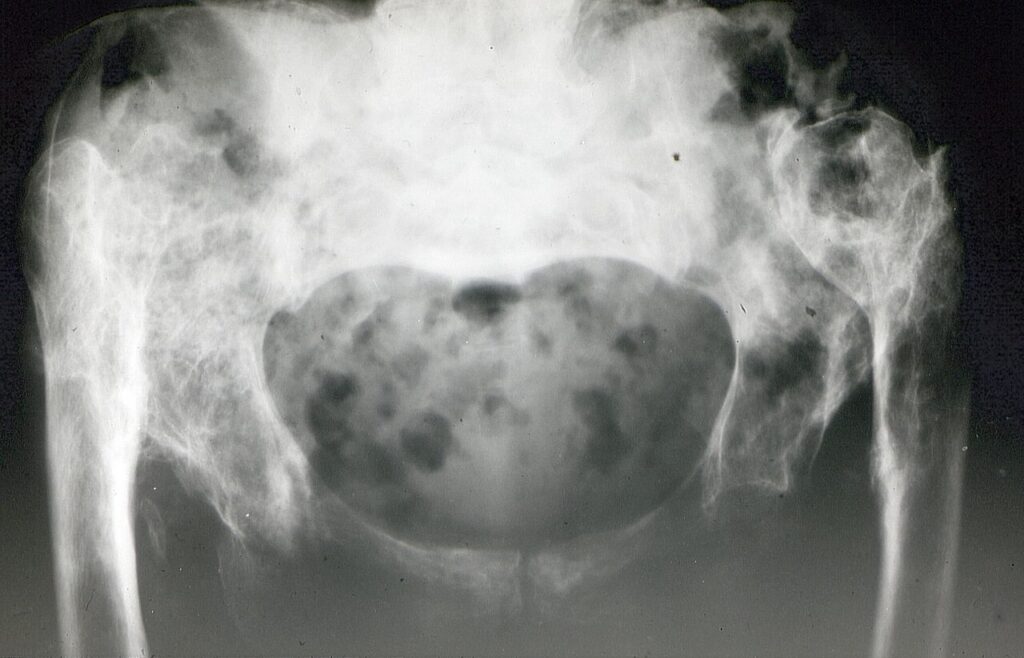
- LCEA below 20 degrees dysplastic, 20 to 25 borderline
- Tönnis angle above 10 degrees
- Anterior centre edge angle on false profile below 20 degrees
- Crossover and posterior wall signs indicate retroversion
Management
- Bernese PAO (Ganz) for younger patients with congruent joints and Tönnis 0 to 1
- PAO preserves the posterior column, keeping the ring stable and allowing early mobilisation
- PAO risks LFCN injury, overcorrection, pubic non-union and sciatic injury
- In THR, a cup at the true acetabulum restores centre of rotation and abductor lever arm
- Small, modular or cemented stems allow independent version setting
- Crowe IV needs subtrochanteric shortening osteotomy, as sciatic palsy rises beyond about 4 cm lengthening
Prognosis
- THR outcomes are inferior to primary OA, with more dislocation, nerve palsy and revision
Reviewed by Professor Phong Tran, Head of Orthopaedic Surgery, Western Health. Last updated 10 October 2026.