
Overview
- Among the commonest causes of dissatisfaction and litigation after THR
- Both depend on offset, centre of rotation and soft tissue tension
- Templating on calibrated radiographs sets cup, stem, neck length and offset targets
- Intraoperative leg length measurement, shuck test and impingement testing
- Counsel before surgery that some length difference is possible
- Small differences usually settle or respond to a shoe raise
Dr Audi Widjaja
Epidemiology
- Dislocation in roughly 1 to 3% of primary THR, more after revision
- LLD is a leading cause of dissatisfaction and medicolegal claims
Aetiology
- Female sex, older age, neuromuscular disease, cognitive impairment and alcohol excess
- Spinopelvic stiffness and abductor deficiency
- Malposition, combined version errors, small heads and inadequate offset or length
- Impingement from osteophytes, cement or a prominent cup
- Posterior approach without capsular repair and low surgeon volume
Investigations
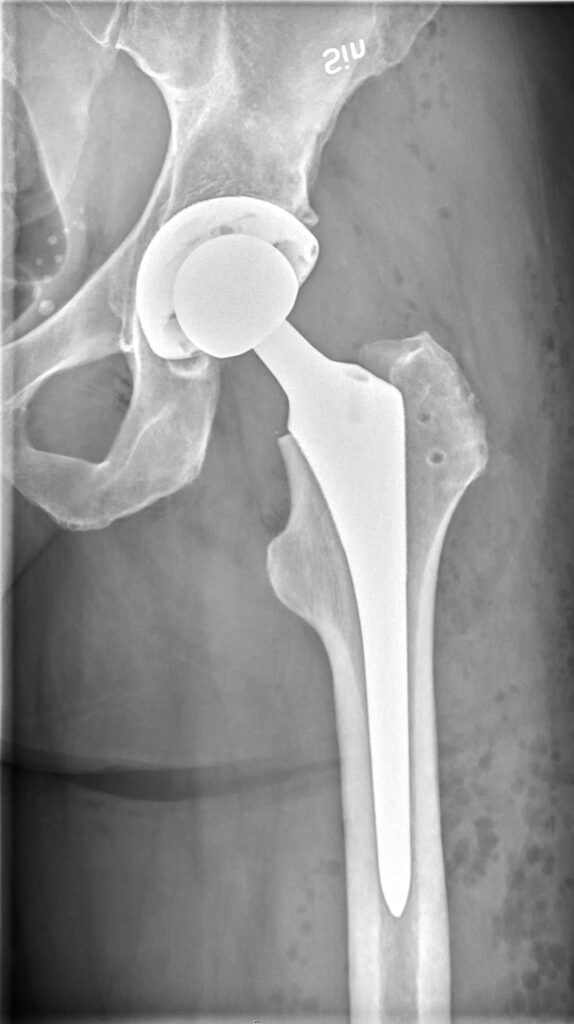
- Template on an AP pelvis with legs internally rotated about 15 degrees
- Measure length from the inter-teardrop or inter-ischial line to each lesser trochanter
Management
- Intraoperative fixed pelvic reference, shuck and drop kick tests, and stability testing in flexion and extension
- Dual mobility increases jump distance, for high risk primaries, fractures, neuromuscular disease and instability revision
- Dual mobility risks intraprosthetic dislocation and wear
- Constrained liners for abductor deficiency or recurrent instability, at the cost of loosening and locking failure
- First dislocation with good components, closed reduction and precautions or bracing
- Recurrent dislocation needs revision targeted to the cause
- Apparent LLD often improves over months with physiotherapy
- True LLD, shoe raise, with under about 1 cm well tolerated
- Revise large symptomatic overlengthening, accepting instability risk
Reviewed by Professor Phong Tran, Head of Orthopaedic Surgery, Western Health. Last updated 10 October 2026.