
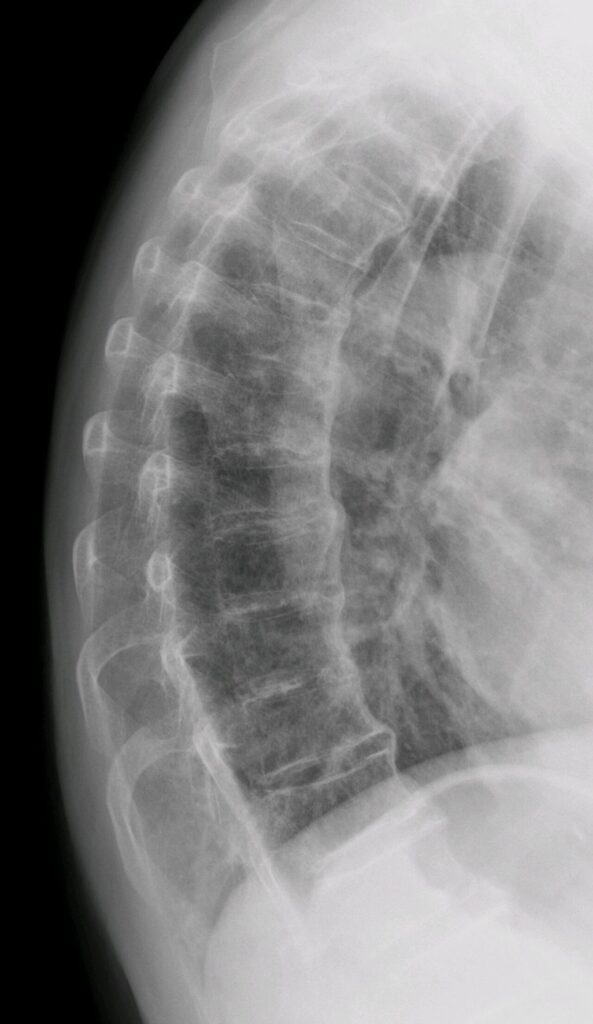
Overview
- Noninflammatory flowing ossification along at least four contiguous vertebral bodies
- Disc height preserved, no sacroiliac or facet ankylosis (Resnick criteria)
- Common in older men, linked with diabetes and obesity
- Large anterior cervical osteophytes can cause dysphagia
- Ankylosed spine behaves like a long bone, so minor trauma causes unstable fractures
- New spinal pain after a fall needs CT, then MRI if CT is normal
Western Health Orthopaedic Registrar presentation – Arthropathy of the Spine by Dr Devinder Garewal
Pathology
- Non-inflammatory enthesopathy with ossification of ligaments and entheses
- Bulky flowing ossification of the anterior longitudinal ligament, right-sided in the thoracic spine from aortic pulsation
- Discs, facets and sacroiliac joints preserved, bone density normal or increased
- Linked with heterotopic ossification after hip arthroplasty
Classification
Resnick criteria
| Criterion | |
|---|---|
| 1 | Flowing ossification along the anterolateral aspect of at least four contiguous vertebral bodies |
| 2 | Relative preservation of disc height |
| 3 | No facet ankylosis and no sacroiliac erosion, sclerosis or fusion |
Original publication Resnick D, Niwayama G. Radiographic and pathologic features of spinal involvement in diffuse idiopathic skeletal hyperostosis (DISH). Radiology. 1976;119(3):559-68.
Differential Diagnosis
- Ankylosing spondylitis affects adults under 40, is HLA-B27 positive and causes sacroiliitis
- AS shows thin marginal syndesmophytes, facet ankylosis and osteoporotic bone
- Spondylosis deformans has disc narrowing and horizontal osteophytes that do not flow continuously
Clinical Features
- Dysphagia, hoarseness or difficult intubation from anterior cervical osteophytes
Management
- Ankylosed spine acts as a lever, so low-energy falls cause unstable three-column fractures
- Assume a fracture with any new spinal pain after trauma
- CT of the whole spine, since radiographs miss many injuries and non-contiguous fractures occur
- MRI for ligamentous injury, epidural haematoma and cord compression
- Immobilise in the pre-injury posture and never force the spine into neutral
- Most need long-segment posterior instrumentation, often percutaneous
Complications
- Missed diagnosis and secondary neurological deterioration
- High mortality in the elderly, comparable to hip fracture
Reviewed by Professor Phong Tran, Head of Orthopaedic Surgery, Western Health. Last updated 10 October 2026.