
Question
Three children present with closed femoral shaft fractures. They are aged 9 months, 4 years and 11 years.
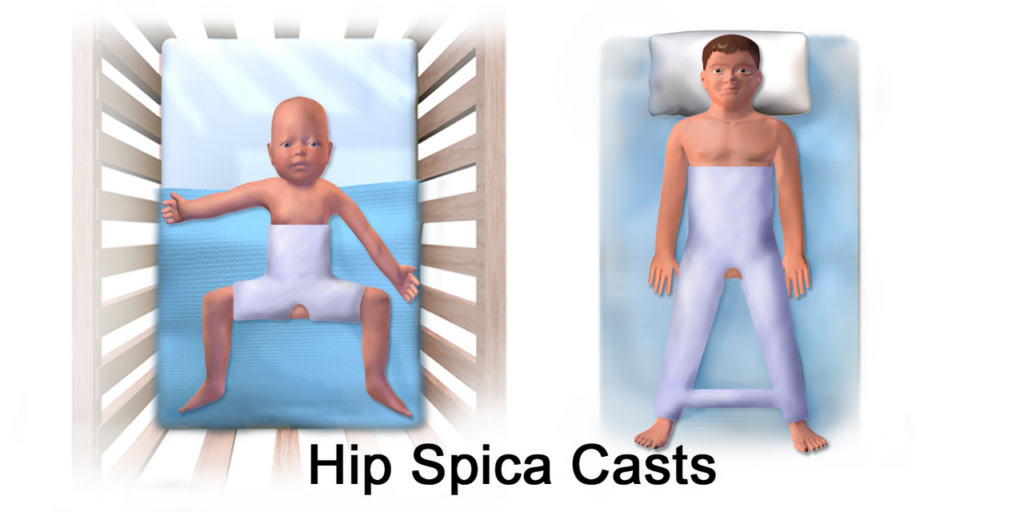
- How does management change with age?
- What is important to consider in the 9 month old?
- What are the complications?
Answer
Management by age
- Under 6 months, Pavlik harness
- 6 months to 5 years, early hip spica cast
- 5 to 11 years, titanium elastic nails for length stable fractures and submuscular plates for length unstable fractures
- Over 11 years or over about 50 kg, lateral entry rigid intramedullary nail, avoiding the piriformis entry because of avascular necrosis risk
- Acceptable alignment and shortening reduce with age
The 9 month old
- Non-accidental injury causes many femoral fractures in children who are not yet walking
- Look for inconsistent history, delayed presentation, bruising and other injuries
- Skeletal survey and ophthalmology review if suspected
- Involve the child protection team
Complications
- Leg length discrepancy, including overgrowth of about 1 cm in children aged 2 to 10
- Malunion and rotational deformity
- Skin problems in spica casts
- Avascular necrosis with piriformis entry nails in adolescents
- Implant prominence and nail removal
Related pages
Author Contributions
Orthofracs team
Reviewed by Professor Phong Tran, Head of Orthopaedic Surgery, Western Health. Last updated 10 October 2026.