
Question
A 12 year old girl, two months after menarche, has a right thoracic curve of 28 degrees on a standing radiograph. She is Risser 0.
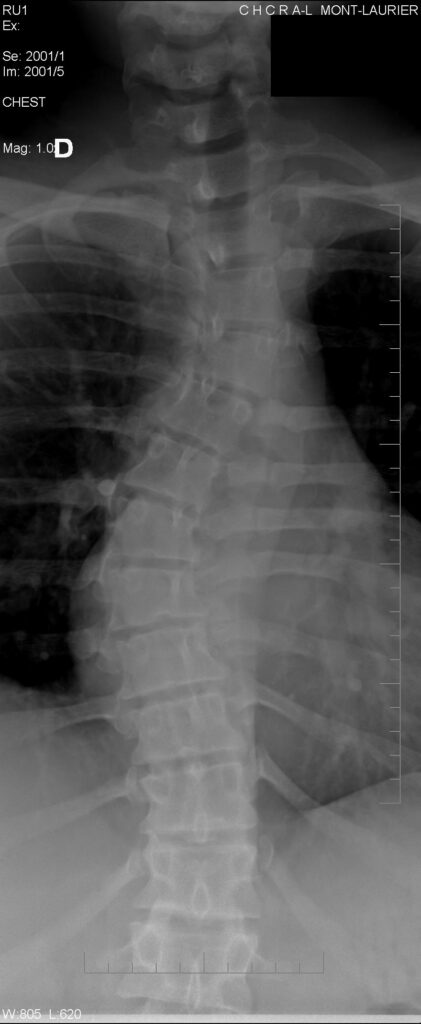
- What features suggest a non-idiopathic cause?
- What determines the risk of progression?
- How would you manage her?
Answer
Red flags for a non-idiopathic curve
- Pain, especially night pain
- Left thoracic curve, rapid progression or an abnormal curve pattern
- Neurological signs, abnormal abdominal reflexes, cavus foot
- Cafe au lait spots, joint laxity or skin dimples
- MRI of the whole spine if any are present, and for juvenile onset curves
Risk of progression
- Skeletal immaturity, Risser 0 to 1, open triradiate cartilage and premenarchal status
- Curve magnitude, with larger curves progressing more
- Thoracic and double curves progress more than lumbar curves
- Peak height velocity, assessed with Sanders staging of the hand
Management
- Curves under 25 degrees are observed with radiographs every 4 to 6 months
- Curves of 25 to 40 degrees in skeletally immature patients are braced, aiming for 18 hours or more daily (BrAIST)
- Curves over 45 to 50 degrees are offered posterior instrumented fusion
- Thoracic curves over 50 degrees continue to progress after maturity
- Vertebral body tethering is an option for selected growing patients
Related pages
Author Contributions
Orthofracs team
Reviewed by Professor Phong Tran, Head of Orthopaedic Surgery, Western Health. Last updated 10 October 2026.