
Question
A 6 year old boy falls from monkey bars. He has a displaced extension type supracondylar humeral fracture. His hand is pink and warm but the radial pulse cannot be felt.
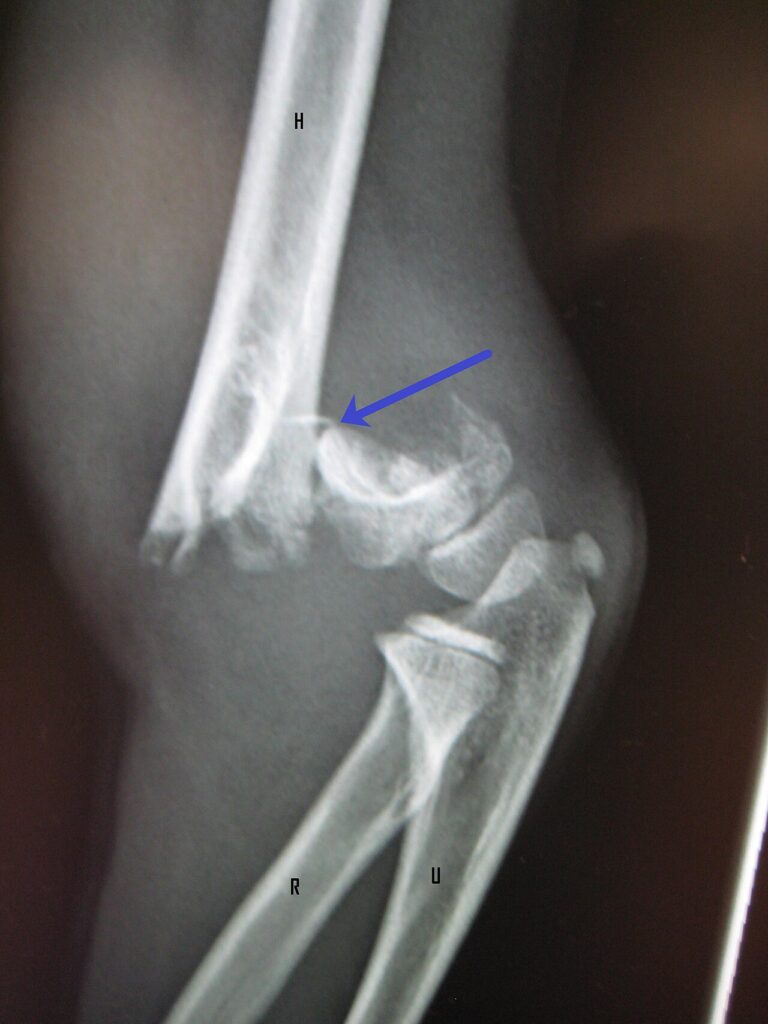
- How is this fracture classified?
- How would you manage the vascular status?
- Describe your surgical technique and complications.
Answer
Classification
- Gartland classification, type I undisplaced, type II angulated with intact posterior cortex, type III completely displaced, type IV multidirectional instability
- Extension type in about 97%, posteromedial displacement risks the radial nerve and brachial artery, posterolateral the median nerve and AIN
Vascular management
- Pink pulseless hand, urgent closed reduction and pinning, then reassess
- Pulse often returns after reduction
- If the hand stays perfused, observe closely in hospital for compartment syndrome
- If the hand is white or becomes poorly perfused after reduction, explore the brachial artery through an anterior approach
- Doppler and pulse oximetry can help monitor
Surgical technique
- Traction in extension, correct coronal displacement, then flex with pressure on the olecranon and pronate for posteromedial fractures
- Check the anterior humeral line and Baumann angle
- Two or three divergent lateral pins engaging both columns
- Medial pin only through a small incision with the elbow extended to protect the ulnar nerve
- Backslab in about 60 to 90 degrees of flexion, pins out at 3 to 4 weeks
Complications
- Nerve injury, the AIN most common, usually recovering
- Compartment syndrome and Volkmann ischaemic contracture
- Cubitus varus (gunstock deformity) from malunion
- Pin tract infection and iatrogenic ulnar nerve injury
Related pages
Author Contributions
Orthofracs team
Reviewed by Professor Phong Tran, Head of Orthopaedic Surgery, Western Health. Last updated 10 October 2026.