
Question
A 2 year old boy with several café au lait spots has anterolateral bowing of the lower leg.
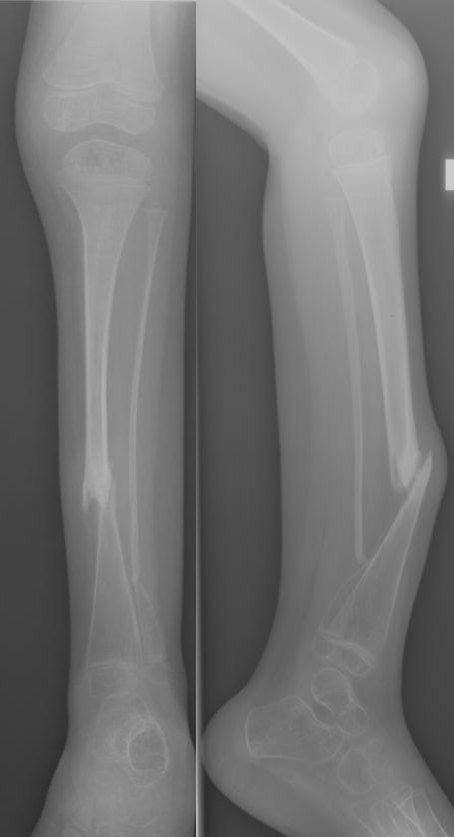
- What is the diagnosis and associated condition?
- How is it classified and how do you manage the bowing before fracture?
- What are the surgical options after fracture?
Answer
Diagnosis
- Anterolateral bowing of the tibia progressing to congenital pseudarthrosis
- About half have neurofibromatosis type 1
- Only a minority of NF1 patients have it
- Distinguish from posteromedial bowing, which is benign and corrects, leaving a leg length difference
Classification and early care
- Boyd and Crawford classifications describe dysplastic, cystic, sclerotic and fractured types
- Total contact clamshell orthosis to prevent fracture
- Avoid corrective osteotomy, it leads to nonunion
After fracture
- Excision of the hamartomatous periosteum and pseudarthrosis
- Intramedullary rod across the ankle (Williams rod)
- Autogenous iliac crest graft
- Cross union technique (tibia to fibula) improves union
- Circular frame with bone transport
- Free vascularised fibula
- Bisphosphonates and BMP as adjuncts
- Refracture is common, keep the rod until maturity
- Amputation (Syme) after repeated failures
Related pages
Author Contributions
Orthofracs team
Reviewed by Professor Phong Tran, Head of Orthopaedic Surgery, Western Health. Last updated 10 October 2026.