
Question
A 26 year old front seat passenger is in a car crash. His right leg is shortened, flexed, adducted and internally rotated.
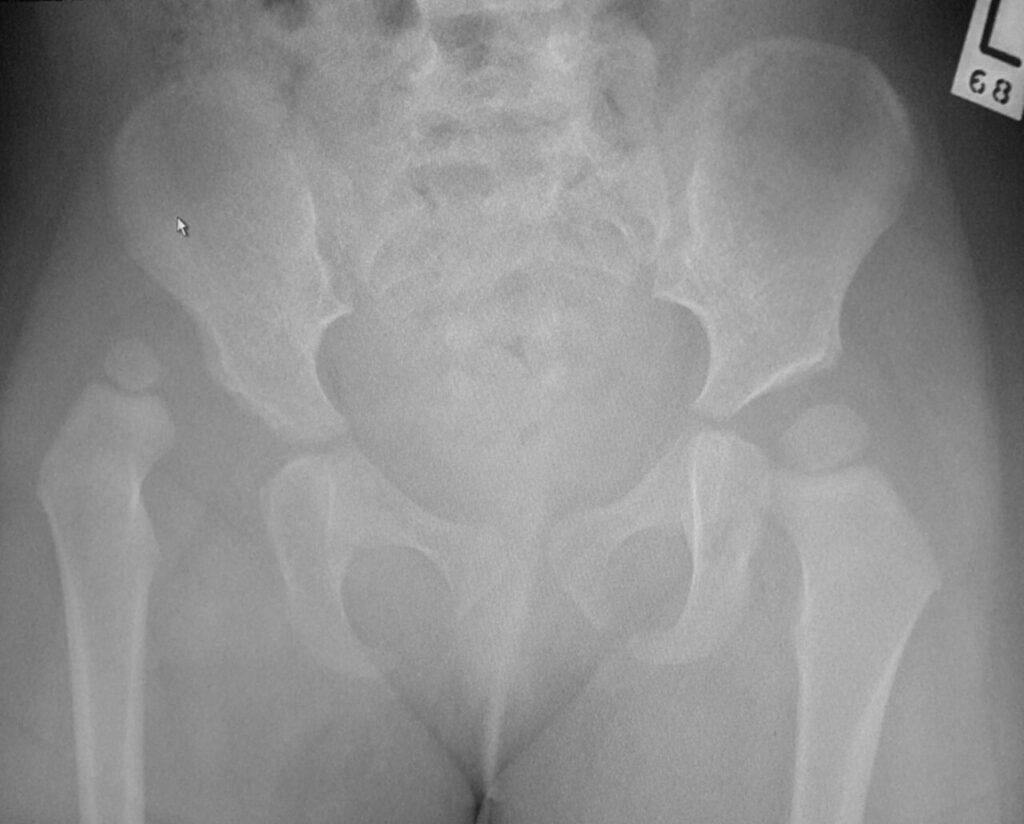
- What is the injury and how should it be assessed?
- Describe the urgent management.
- What are the long term complications?
Answer
Injury and assessment
- Posterior dislocation of the hip, dashboard mechanism
- Check sciatic nerve function, peroneal division most often affected
- Look for ipsilateral knee injury (patella, PCL) and femoral shaft fracture
- Look for acetabular posterior wall and femoral head fractures (Pipkin)
Urgent management
- Closed reduction under sedation or general anaesthesia within 6 hours
- Allis or Bigelow manoeuvre
- Do not attempt closed reduction with an undisplaced femoral neck fracture
- Post reduction CT for incarcerated fragments, non concentric reduction and fracture
- Open reduction if irreducible, through a posterior Kocher-Langenbeck approach
- Fix posterior wall fractures causing instability
- Document neurology before and after reduction
Complications
- Avascular necrosis, risk rises with delay over 6 hours
- Post-traumatic arthritis, the most common late complication
- Sciatic nerve palsy in about 10%
- Heterotopic ossification
- Recurrent dislocation is rare
Related pages
Author Contributions
Orthofracs team
Reviewed by Professor Phong Tran, Head of Orthopaedic Surgery, Western Health. Last updated 10 October 2026.