
Anatomy
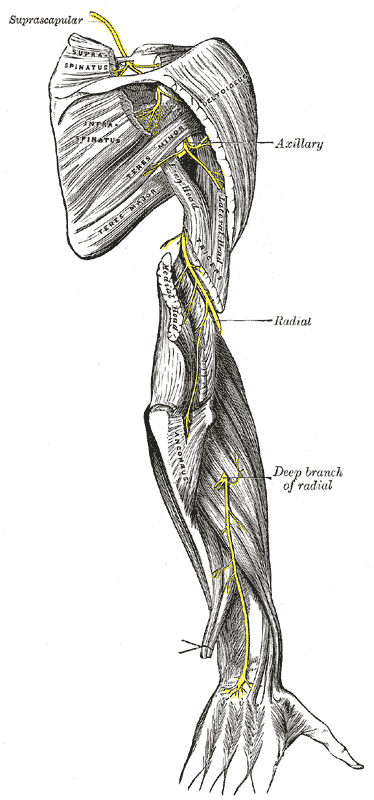
- Terminal branch of the posterior cord, C5 to T1
- Passes through the triangular interval with profunda brachii
- Spiral groove between lateral and medial triceps heads
- Pierces the lateral intermuscular septum in the distal third of the arm
- Supplies brachioradialis and ECRL above the elbow
- Divides into superficial radial nerve and PIN at the elbow
- PIN passes under the arcade of Frohse through supinator
- EIP is the last muscle to recover
Clinical Features
- Palsy in around one in ten humeral shaft fractures
- Distal third spiral fracture (Holstein-Lewis)
- Most are neurapraxias and recover spontaneously
- PIN syndrome gives painless finger and thumb extension weakness without sensory loss
- Wrist extends with radial deviation as ECU is weak
- Arcade of Frohse is the commonest compression site
- Other sites are radiocapitellar bands, leash of Henry, ECRB edge and distal supinator
- Intact tenodesis effect excludes extensor tendon rupture
- Radial tunnel syndrome is pain without weakness, with mobile wad tenderness
- Pain on resisted supination and resisted middle finger extension
- Wartenberg syndrome, superficial radial nerve compression between brachioradialis and ECRL
Investigations
- EMG at 6 to 12 weeks if no recovery
- Brachioradialis is the first muscle to recover
- Nerve conduction usually normal in radial tunnel syndrome
- MRI or ultrasound for a mass in PIN syndrome
Management
- Observe closed fractures with primary palsy, using a wrist splint and passive motion
- Explore if no recovery at 3 to 6 months
- Early exploration for open fractures, penetrating or vascular injury
- Nerve transfers, FDS to ECRB, FCR or palmaris longus branch to PIN
- Tendon transfers, pronator teres to ECRB, FCR to EDC, palmaris longus to EPL
- PIN syndrome decompression if no recovery
- Radial tunnel syndrome managed nonoperatively first
Reviewed by Professor Phong Tran, Head of Orthopaedic Surgery, Western Health. Last updated 10 October 2026.