
Anatomy
- Formed from the lateral (C5 to C7) and medial (C8, T1) cords
- Passes under the lacertus fibrosus, between the heads of pronator teres and under the FDS arch
- AIN arises just distal to the elbow and supplies FPL, FDP to index and middle, and pronator quadratus
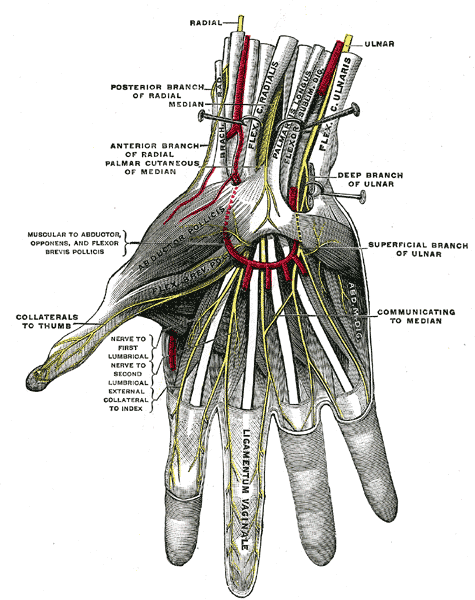
- Palmar cutaneous branch arises proximal to the wrist, superficial to the transverse carpal ligament
- Recurrent motor branch is extraligamentous, subligamentous or transligamentous
- Hand supply to radial two lumbricals, opponens pollicis, APB and superficial head of FPB
Clinical Features
Low lesion
- Thenar wasting with loss of thumb abduction and opposition (ape hand)
- Sensory loss over the radial three and a half digits
High lesion
- Adds loss of FPL, FDP to index and middle, FDS and weak pronation
- Benediction attitude on attempted fist and a positive Ochsner clasp test
AIN syndrome
- Pure motor palsy with no sensory loss
- Cannot make an O sign, pinching with thumb IP and index DIP hyperextended
- Causes include deep head pronator teres bands, the FDS arch and Gantzer muscle
- AIN is the nerve most often injured in paediatric supracondylar fractures
- Parsonage-Turner syndrome often presents as AIN palsy after severe shoulder pain
- Intact tenodesis effect excludes FPL rupture
Pronator syndrome
- Compression at ligament of Struthers, lacertus fibrosus, pronator teres or FDS arch
- Volar forearm ache and paraesthesia including the palm, usually without nocturnal symptoms
- Provoked by resisted pronation, resisted elbow flexion in supination or resisted middle finger PIP flexion
Carpal tunnel syndrome
- Most common compression neuropathy, tunnel holds the median nerve and nine flexor tendons
- Nocturnal paraesthesia, positive Phalen and Durkan tests, thenar wasting when advanced
- Nerve conduction studies confirm the diagnosis and grade severity
Management
- AIN palsy without structural cause recovers with observation over several months
- Pronator syndrome, nonoperative care then release of all potential sites
- Carpal tunnel syndrome, night splints and corticosteroid injection, then open or endoscopic release
Complications
- Carpal tunnel release risks palmar cutaneous or recurrent motor branch injury
Reviewed by Professor Phong Tran, Head of Orthopaedic Surgery, Western Health. Last updated 10 October 2026.