
Anatomy
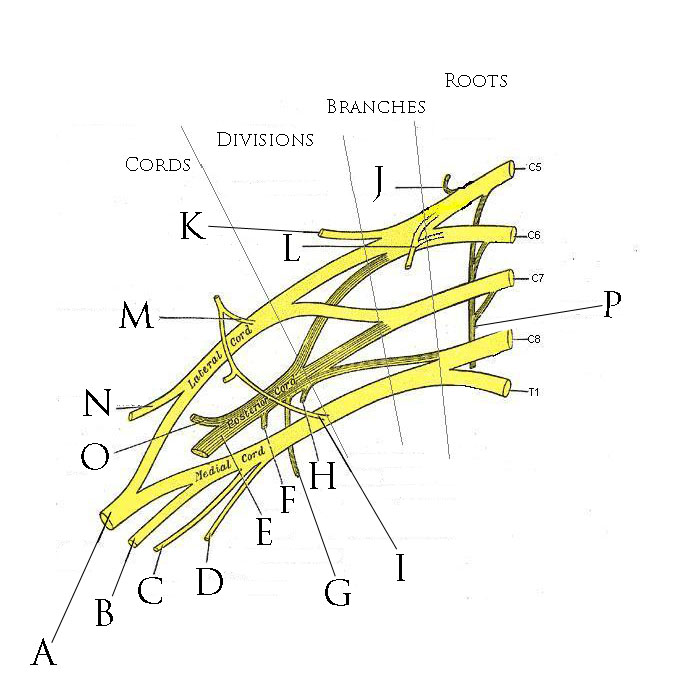
- Ventral rami of C5 to T1, forming roots, trunks, divisions, cords and terminal branches
- Supraclavicular lesions (roots, trunks) more common in trauma than infraclavicular
Aetiology
- Mostly high energy trauma, especially motorcycle accidents
- Head and shoulder separation injures C5 and C6, forced arm abduction injures C8 and T1
Classification
- Preganglionic lesions (root avulsion) lie proximal to the dorsal root ganglion and cannot be repaired
- Postganglionic lesions can be repaired or grafted
- Upper roots, anchored to transverse processes, more often rupture postganglionically
- C8 and T1 more often avulse
Clinical Features
Preganglionic signs
- Horner syndrome from T1 sympathetic involvement
- Winging from long thoracic palsy, rhomboid weakness from dorsal scapular palsy
- Raised hemidiaphragm from phrenic palsy
- Severe burning pain in an anaesthetic limb
- Absent supraclavicular Tinel sign, a positive sign suggesting postganglionic rupture
Associated injuries
- Subclavian or axillary artery injury
- Fractures of clavicle, scapula, first rib and cervical spine
Investigations
- Chest radiograph for rib fractures and diaphragm position
- CT myelography or MRI for root avulsion and pseudomeningocele
- NCS and EMG at 3 to 4 weeks, with preserved SNAPs and paraspinal denervation indicating avulsion
Management
- Sharp open injuries explored and repaired early
- Closed injuries observed, explored at 3 to 6 months without recovery
- Surgery within about 6 months gives the best results
- Priorities are elbow flexion, then shoulder stability, then hand sensation and function
- Neurolysis and sural nerve grafting
- Oberlin ulnar fascicle to biceps and double fascicular transfers
- Spinal accessory to suprascapular, triceps branch to axillary, intercostal and contralateral C7 transfers
- Free gracilis transfer for late or pan-plexus injuries
- Steindler flexorplasty, latissimus transfer and shoulder arthrodesis as secondary procedures
Prognosis
- Upper plexus injuries have the best outcome
- Pan-plexus avulsions leave a poorly functioning hand
Obstetric palsy
- Linked to shoulder dystocia, macrosomia and instrumented delivery
- Erb palsy (C5, C6) most common, with waiter’s tip posture
- Absent biceps recovery by 3 to 6 months indicates microsurgical reconstruction
- Internal rotation contracture and glenohumeral dysplasia are common sequelae
Reviewed by Professor Phong Tran, Head of Orthopaedic Surgery, Western Health. Last updated 10 October 2026.