
Question
A 72 year old woman with a 20 degree correctable valgus knee has undergone total knee arthroplasty.
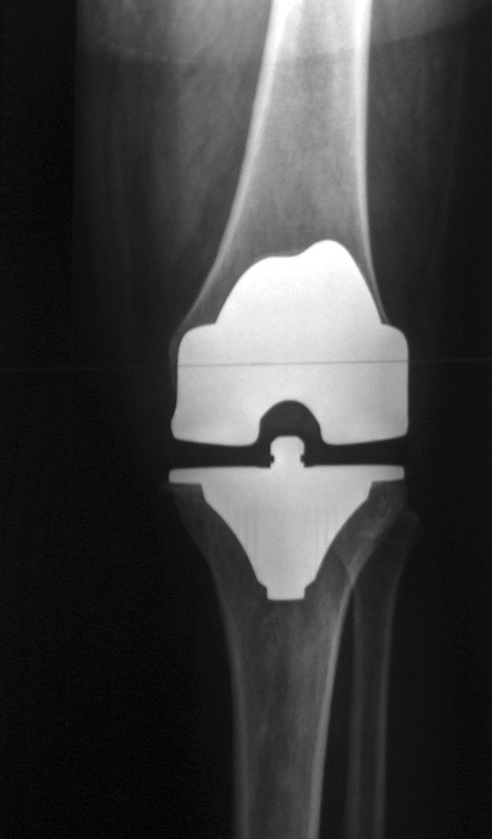
- What are the bony and soft tissue features of the valgus knee?
- Describe the order of soft tissue release.
- What complications are more common?
Answer
Features
- Hypoplastic lateral femoral condyle, posterior and distal
- Lateral tibial bone loss
- Tight lateral structures, ITB, popliteus, LCL, posterolateral capsule
- Stretched medial structures
- External rotation of the tibia and patellar maltracking
Ranawat classification
| Type | Description |
|---|---|
| I | Under 10 degrees, correctable, medial soft tissues intact |
| II | Over 10 degrees, medial soft tissues stretched |
| III | Severe, after HTO, medial structures incompetent |
Release and technique
- Distal femoral valgus cut of 3 to 5 degrees
- Avoid internal rotation of the femoral component by referencing posterior condyles, use the transepicondylar axis
- Release the posterolateral capsule and ITB (pie crusting) for tightness in extension
- Popliteus and LCL for tightness in flexion
- Lateral parapatellar approach is an option
- Constrained (CCK) implant if the MCL is incompetent
Complications
- Common peroneal nerve palsy after correction of valgus with flexion contracture
- Treat by flexing the knee and removing dressings
- Instability
- Patellar maltracking
Related pages
Author Contributions
Orthofracs team
Reviewed by Professor Phong Tran, Head of Orthopaedic Surgery, Western Health. Last updated 10 October 2026.