
Question
A 51 year old woman with rheumatoid arthritis has severe destruction of her right knee and is being considered for total knee arthroplasty.
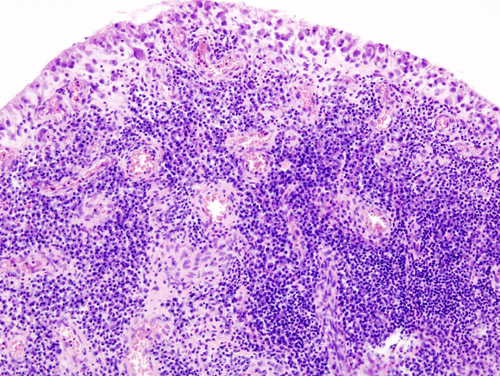
- What are the major orthopaedic manifestations of rheumatoid arthritis?
- What must you consider when planning the operation?
- What prosthesis would you consider, and what are the intraoperative and postoperative considerations?
Answer
Orthopaedic manifestations
- Hand, MCP ulnar drift, swan neck and boutonniere deformities, extensor tendon rupture and rheumatoid nodules
- Wrist, caput ulnae, radiocarpal and DRUJ destruction
- Elbow and shoulder synovitis and erosive arthritis
- Cervical spine, atlantoaxial instability, basilar invagination and subaxial subluxation
- Hip, protrusio acetabuli
- Knee, valgus deformity and flexion contracture
- Foot, hallux valgus, lesser toe deformities and forefoot metatarsalgia
Planning
- Flexion and extension cervical spine radiographs before anaesthesia
- Plan with the rheumatologist, continuing conventional DMARDs and withholding biologics around surgery
- Skin fragility and steroid use
- Upper limb function for walking aids
- Address hip disease first if severe
- Assess bone stock, deformity and ligament integrity
Prosthesis and surgical considerations
- Cemented posterior stabilised design is usually chosen, as the PCL is often deficient
- Constrained or hinged implants for severe ligament insufficiency
- Resurface the patella
- Careful soft tissue handling and wound closure
- Postoperative infection risk is higher, with close wound review and early mobilisation
Related pages
Author Contributions
Orthofracs team
Reviewed by Professor Phong Tran, Head of Orthopaedic Surgery, Western Health. Last updated 10 October 2026.