
Definition
- Also called giant cell sarcoma
- High grade sarcoma arising with GCTB
- Distinct from benign GCTB
- Distinct from benign metastasising GCTB, which has histologically benign lung deposits
Classification
| Type | Description |
|---|---|
| Primary | High grade sarcoma coexisting with conventional GCTB at first presentation |
| Secondary | Sarcoma at the site of previously treated GCTB, more common than primary |
- Most secondary cases follow radiotherapy, after a latent period of several years
- A smaller group arise after surgery alone, sometimes after multiple local recurrences
- Sarcomatous change reported on denosumab, so atypical radiological change on denosumab warrants biopsy
Epidemiology
- Rare, a small percentage of all giant cell tumours
- Patients older than in conventional GCTB
- Secondary cases present years to decades after initial treatment
- Sites mirror GCTB, with distal femur, proximal tibia, distal radius and sacrum
Pathology
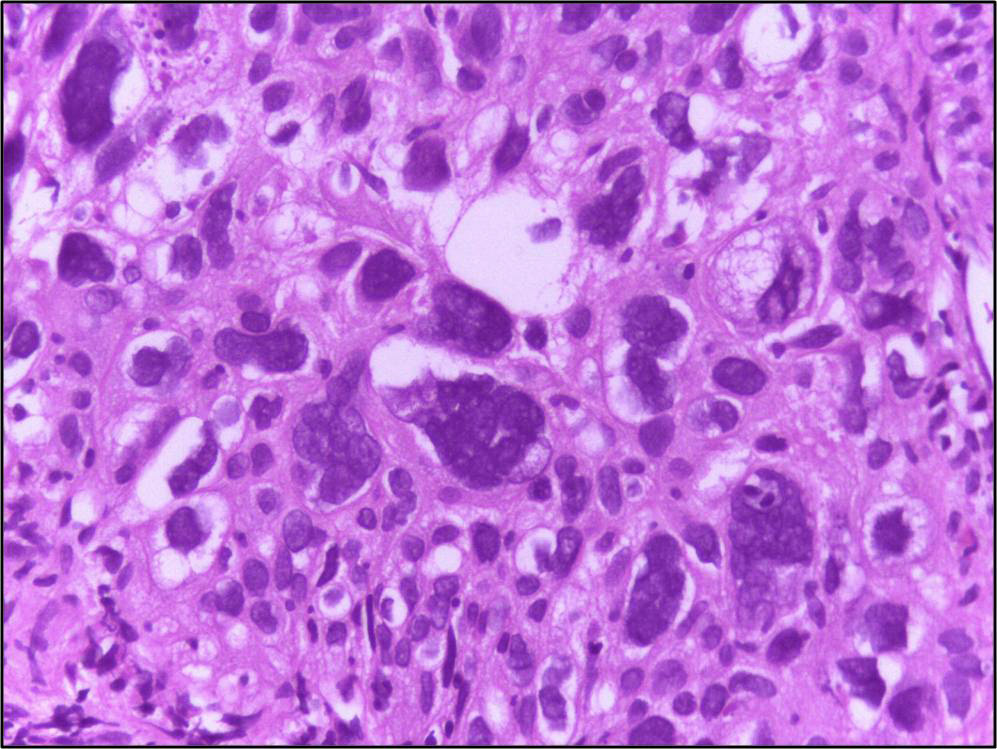
- Sarcoma is usually high grade osteosarcoma, fibrosarcoma or undifferentiated pleomorphic sarcoma
- Primary cases show conventional GCTB alongside the sarcoma
- Benign precursor may be absent in secondary cases
- H3F3A G34W mutation confirms origin from GCTB
Clinical Features
- New or increasing pain at a treated GCTB site
- Rapidly enlarging mass or pathological fracture
- Prior radiotherapy to the region
Investigations
- Radiographs show aggressive lysis, cortical destruction, ill defined margins and soft tissue mass
- Lesion may arise adjacent to prior graft or cement
- MRI for local extent, CT chest and bone scan or PET for staging
- Biopsy at a sarcoma centre along the future resection tract
Differential Diagnosis
- Local recurrence of benign GCTB
- Giant cell rich osteosarcoma
- Brown tumour of hyperparathyroidism
- De novo undifferentiated pleomorphic sarcoma
Management
- Treated as high grade bone sarcoma
- Neoadjuvant and adjuvant chemotherapy in suitable patients
- Wide resection with endoprosthetic or biological reconstruction
- Amputation when a wide margin with a functional limb is not achievable
- Radiotherapy has a limited role given frequent post radiation aetiology
Prognosis
- Poor, similar to or worse than other high grade bone sarcomas
- Secondary and post radiation cases fare worse than primary cases
- Pulmonary metastases are the usual cause of death
Reviewed by Professor Phong Tran, Head of Orthopaedic Surgery, Western Health. Last updated 10 October 2026.