
Question
A 40 year old gardener pricked her ring finger on a rose thorn two days ago. The finger is now swollen and very painful.
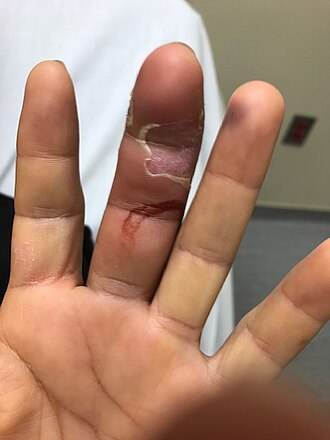
- What clinical signs confirm the diagnosis?
- Describe the anatomy of spread.
- Outline your management.
Answer
Kanavel signs
- Fusiform swelling of the whole digit
- Finger held in slight flexion
- Tenderness along the flexor sheath
- Pain on passive extension, the earliest and most reliable sign
Anatomy of spread
- Thumb sheath continues as the radial bursa
- Little finger sheath continues as the ulnar bursa
- Radial and ulnar bursae may communicate through the space of Parona, giving a horseshoe abscess
- Index, middle and ring sheaths end at the A1 pulley level
- Rupture into the midpalmar or thenar spaces
Management
- Staphylococcus aureus and streptococci most common
- Consider Pasteurella after animal bites, Eikenella after human bites, atypical mycobacteria after chronic water exposure
- Early cases under 48 hours may settle with elevation, splinting and intravenous antibiotics
- Review at 12 to 24 hours and operate if not improving
- Closed catheter irrigation through a proximal A1 incision and distal incision near A5
- Open debridement for advanced cases, preserving A2 and A4
- Hand therapy early to prevent adhesions
Complications
- Stiffness and tendon adhesion
- Tendon necrosis and rupture
- Amputation in diabetics and delayed presentation
Related pages
Author Contributions
Orthofracs team
Reviewed by Professor Phong Tran, Head of Orthopaedic Surgery, Western Health. Last updated 10 October 2026.