
Question
A 35 year old man falls 3 metres from a ladder, landing on his heels. CT shows a displaced intra-articular calcaneal fracture.
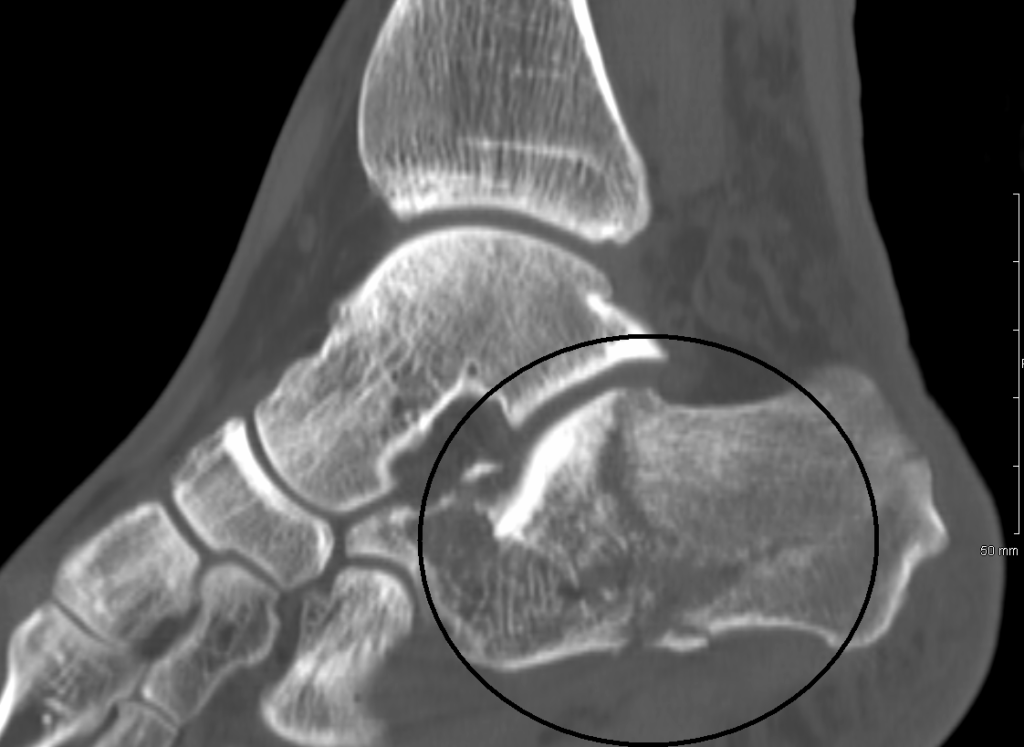
- How are these fractures classified?
- What are the associated injuries?
- Outline your management.
Answer
Classification
- Essex-Lopresti, tongue type and joint depression
- Sanders CT classification of the posterior facet, types I to IV by the number of articular fragments
- Böhler angle (normal 20 to 40 degrees) is reduced, and the angle of Gissane is increased
Associated injuries
- Lumbar spine fractures in about 10%
- Contralateral calcaneal fracture in about 10%
- Compartment syndrome of the foot
- Tibial plateau and pelvic injuries
Management
- Elevation and splintage, waiting for swelling to settle with a positive wrinkle test
- Non-operative care for undisplaced fractures and patients who smoke, have diabetes or vascular disease (UK HeFT trial showed no benefit from ORIF on average)
- ORIF through an extensile lateral approach or a sinus tarsi approach for displaced Sanders II and III fractures in selected patients
- Urgent reduction of tongue type fractures threatening the skin
- Primary subtalar fusion for Sanders IV fractures
- Wound breakdown and infection are the main complications of open surgery
Related pages
Author Contributions
Orthofracs team
Reviewed by Professor Phong Tran, Head of Orthopaedic Surgery, Western Health. Last updated 10 October 2026.