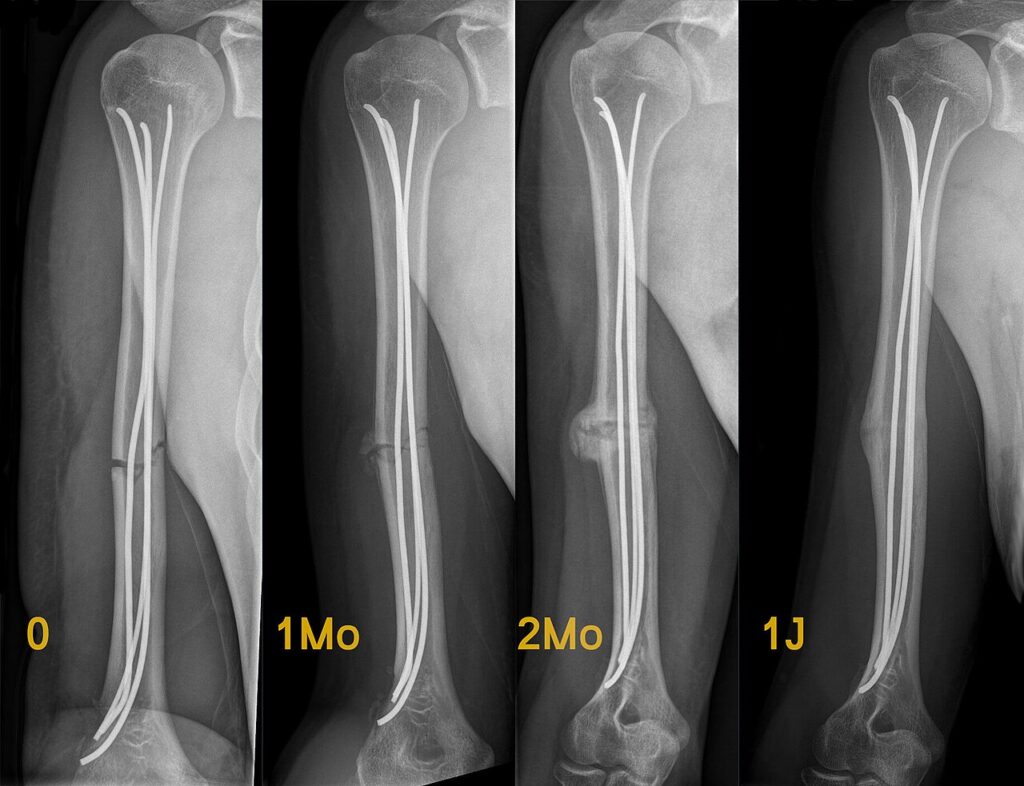
 Serial radiographs of a humeral shaft fracture healing with callus. Image by Hellerhoff, Wikimedia Commons, CC BY-SA 4.0.
Definition
- Restoration of bone continuity and strength after fracture, by regeneration without scar
Pathology
| Type | Mechanical environment | Process |
|---|
| Primary (direct) | Absolute stability, interfragmentary strain under 2% | Cutting cones of osteoclasts and osteoblasts cross the fracture. No callus |
| Secondary (indirect) | Relative stability, strain 2 to 10% | Endochondral ossification through callus |
- Strain over 10% leads to fibrous tissue or nonunion (Perren strain theory)
- Most fractures heal by a mix of both types
Stages of Secondary Healing
| Stage | Features |
|---|
| Inflammation | Haematoma, platelets and macrophages release PDGF, TGF-beta and IL-1. First week |
| Soft callus | Mesenchymal cells form cartilage and fibrous tissue. Angiogenesis driven by VEGF |
| Hard callus | Cartilage calcifies and is replaced by woven bone. Clinical union |
| Remodelling | Woven bone replaced by lamellar bone along stress lines (Wolff law). Months to years |
- BMP-2 and BMP-7 are osteoinductive and used clinically
- The diamond concept (Giannoudis 2007) lists osteogenic cells, osteoconductive scaffold, growth factors, mechanical stability and vascularity
Factors Impairing Healing
- Smoking and nicotine
- Diabetes, malnutrition and vitamin D deficiency
- Corticosteroids. NSAID effect remains debated
- Infection
- Poor blood supply from high energy injury or soft tissue stripping
- Excess or inadequate stability
Related Pages
Reviewed by Professor Phong Tran, Head of Orthopaedic Surgery, Western Health. Last updated 10 October 2026.