
Question
An 87 year old woman has a squeaking, painful hip 20 years after total hip arthroplasty.
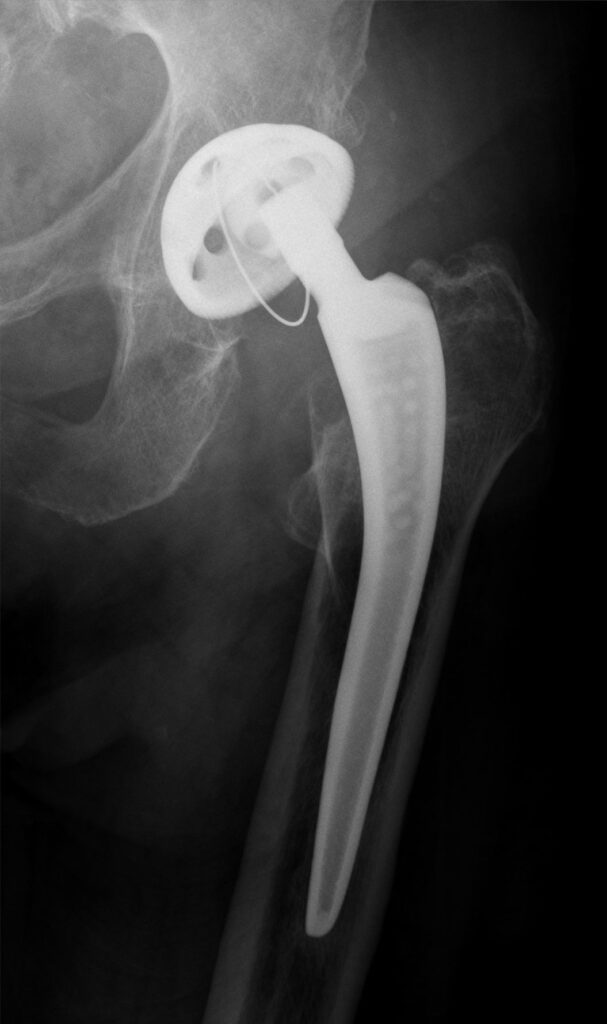
- Describe the radiograph.
- What factors affect polyethylene wear?
- How would you manage this?
Answer
Radiograph
- Eccentric position of the femoral head in the acetabular shell
- Severe polyethylene wear or a failed liner
- Look for metal on metal contact, osteolysis and metallosis
Factors affecting wear
- Conventional polyethylene sterilised in air oxidises
- Highly cross linked polyethylene reduces wear by over 80%
- Vitamin E stabilised polyethylene reduces oxidation
- Larger heads increase volumetric wear with conventional polyethylene
- Steep cup inclination and malposition
- Third body debris (cement, metal)
- Young, active and heavy patients
Wear measurements
| Type | Rate |
|---|---|
| Conventional polyethylene | About 0.1 to 0.2 mm per year |
| Osteolysis threshold | Over 0.1 mm per year |
| Highly cross linked | Under 0.05 mm per year |
Management
- Exclude infection
- Assess shell fixation and position
- Liner exchange with larger head if shell is well fixed and well positioned
- Cement a liner into a shell with a damaged locking mechanism
- Full revision for loose or malpositioned shells
- Debride metallosis and bone graft lytic defects
- Dual mobility or constrained liner for instability
Related pages
Author Contributions
Orthofracs team
Reviewed by Professor Phong Tran, Head of Orthopaedic Surgery, Western Health. Last updated 10 October 2026.