
Question
A 58 year old woman with type 2 diabetes has a painful middle finger that locks in flexion each morning and needs her other hand to straighten it.
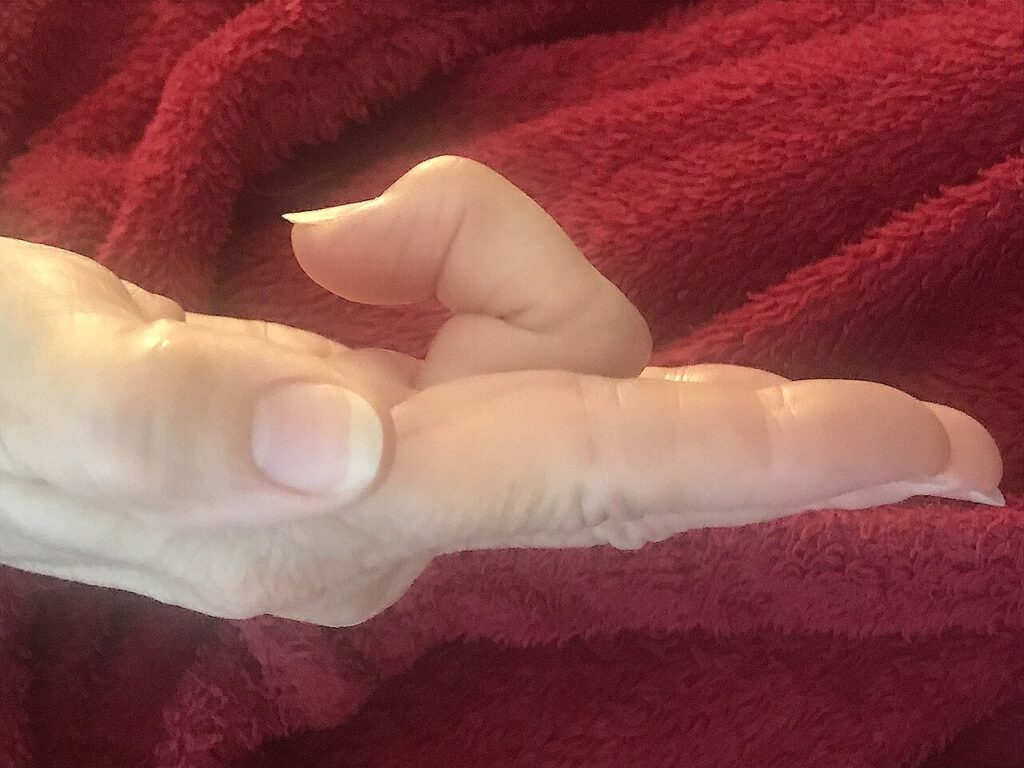
- What is the diagnosis and the pathology?
- How is it graded?
- Outline management, including surgical pitfalls.
Answer
Diagnosis and pathology
- Stenosing flexor tenosynovitis (trigger finger)
- Mismatch between the flexor tendons and the A1 pulley
- Fibrocartilaginous metaplasia of the A1 pulley
- Nodule on the flexor tendons
- Associated with diabetes, rheumatoid arthritis, gout, amyloid and carpal tunnel syndrome
Green grading
| Grade | Feature |
|---|---|
| I | Pain and tenderness at A1, no triggering |
| II | Triggering, actively corrects |
| III | Locking, needs passive extension or cannot fully flex |
| IV | Fixed flexion contracture of the PIP joint |
Management
- Splinting of the MCP joint in extension for early cases
- Corticosteroid injection into the sheath, lower success in diabetics
- Open A1 pulley release for failed injection, grades III and IV
- Percutaneous release in experienced hands, avoid in the thumb and index finger
- Protect digital nerves, which lie close in the thumb (radial digital nerve) and index finger
- Preserve the A2 pulley to avoid bowstringing
- Rheumatoid patients need tenosynovectomy, avoid A1 release which worsens ulnar drift
Related pages
Author Contributions
Orthofracs team
Reviewed by Professor Phong Tran, Head of Orthopaedic Surgery, Western Health. Last updated 10 October 2026.