
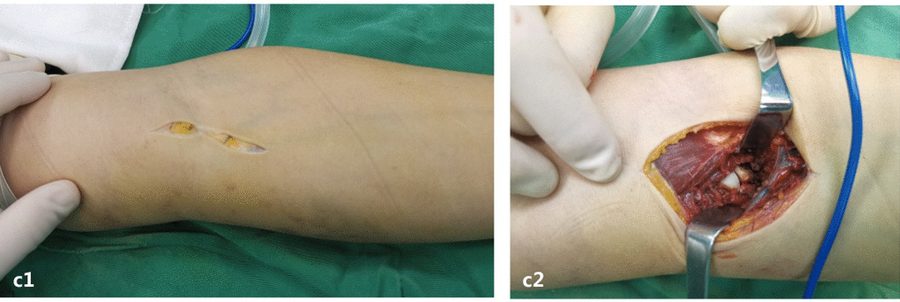
The anterior approach to the cubital fossa exposes the distal biceps tendon, median nerve, brachial artery and anterior elbow joint. It is used for distal biceps repair and for nerve or vascular exploration, protecting the lateral antebrachial cutaneous nerve and the radial nerve and its branches.
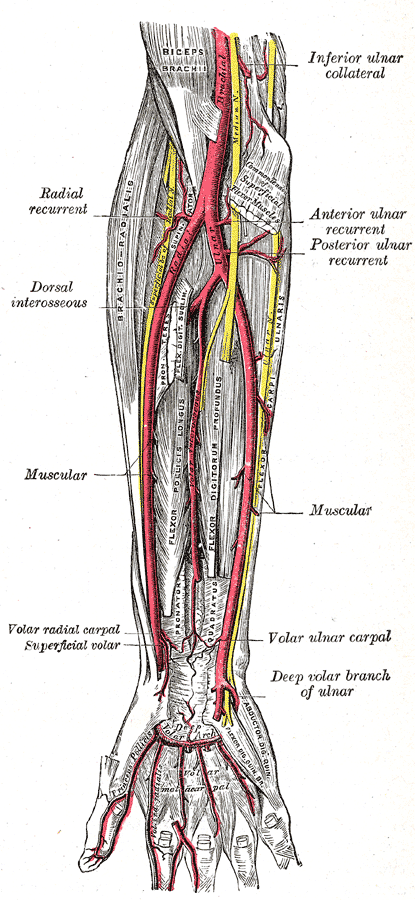
Indications
- Reinsertion of biceps tendon
- Release of anterior capsular contractions
- Repair of nerves
- Exploration of the pulseless pale paediatric supracondylar humeral fracture
Position
- Supine
- Armboard
Landmarks
- Brachioradialis
- Tendon of biceps
- Anterior elbow crease
Incision
- Curved longitudinal gentle S shaped incision over anterior aspect of elbow
- Start: 5cm above elbow crease on medial side of biceps
- Cross elbow crease obliquely
- End: continue on the medial border of brachioradialis
Internervous Plane
- Proximally
- Brachioradialis
- Brachialis
- Distally
- Brachioradialis
- Radial nerve
- Pronator teres
- Brachioradialis
Superficial Dissection
- Ligate numerous veins
- Identify & preserve lateral cutaneous nerve of forearm
- Between biceps & brachialis
- Identify bicipital aponeurosis & incise it close to its origins at the biceps tendon
- Being wary of brachial artery which runs deep to aponeurosis
- Identify radial artery & trace it proximally to its origin in the brachial artery
- Brachial vein & median Nerve run medial to artery
Deep Dissection
- Develop plane between
- Medially biceps & brachialis
- Laterally BR
- Supinate forearm
- Incise origin of supinator
Dangers
- Lateral cutaneous nerve of forearm
- Radial artery
- PIN
Reviewed by Professor Phong Tran, Head of Orthopaedic Surgery, Western Health. Last updated 10 October 2026.