
- Haemoglobin aa is normal
- Haemoglobin aS is sickle cell trait
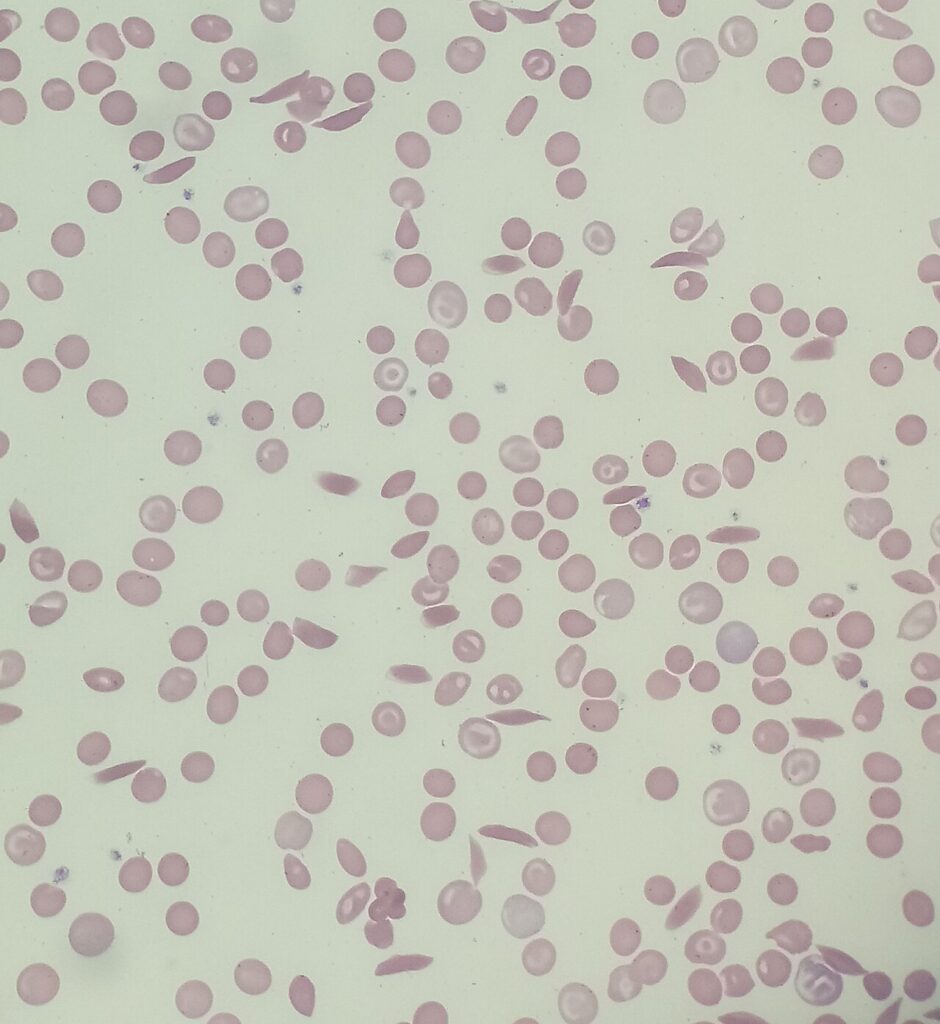
- Haemoglobin SS is sickle cell disease
- Haemoglobin SC – second most common
- With low flow, ↓ O2 tension leads to polymerization of Hb S & sickling
- Haemolytic anaemia may occur
- Vaso-occlusive episodes may occur
- Hepatosplenomegaly
- Marrow expansion
Musculoskeletal Problems
- Dactylitis – infarction of bone can occur in a bone & resemble osteomyelitis
- Osteomyelitis
- AVN
- Septic arthritis
- Thin long bone cortices
- Saucer vertebrae
Sickle Cell Crisis
- An extremely painful episode in which there is bony infarction & must rule out infection
Osteomyelitis in Sickle Cell
- Most common due to secondary hypersplenism & defective opsonization
- Salmonella most common bacteria to infect – 75%
- Staph 10%
- Diaphyseal of humerus & tibia
- Multiple sites may occur
- Must do blood cultures & aspirate the affected areas
Treatment
- Chloramphenicol or penicillin – salmonella
- Clox for staph
- Debride through cortical window
Septic Arthritis in Sickle Cell
- Not as frequent as osteomyelitis
- Caused by osteo at times
- Salmonella is not as common
Reactive Arthritis
- May get ↑ in temperature & WBC <20000
- Lasts 1-2 weeks
- Splint & NSAIDS
AVN in Sickle Cell
- Femoral head ~ 10 % (50% bilateral)
- Increases with Hb SS
- MRI not as good
- MRI good for extent
Treatment
- Lateral pillar intact – non operative
- Total Head or Lateral Pillar – osteotomy
- Arthroplasty do poorly
- Do not fuse BILateral DISEASE
- Humeral head – 5.6%
- Less symptomatic
- Children often heal this lesion
- Arthroplasty has poor results
Surgical Consideration
- Adequate hydration
- Avoid hypothermia
- Avoid deoxygenation
- Transfuse PRN
- Tourniquet is OK
Reviewed by Professor Phong Tran, Head of Orthopaedic Surgery, Western Health. Last updated 10 October 2026.