
Question
A 24 year old builder presents with wrist pain 9 months after a fall onto his outstretched hand. He did not seek treatment at the time. Radiographs show a scaphoid waist fracture with sclerosis and cysts at the fracture margins.
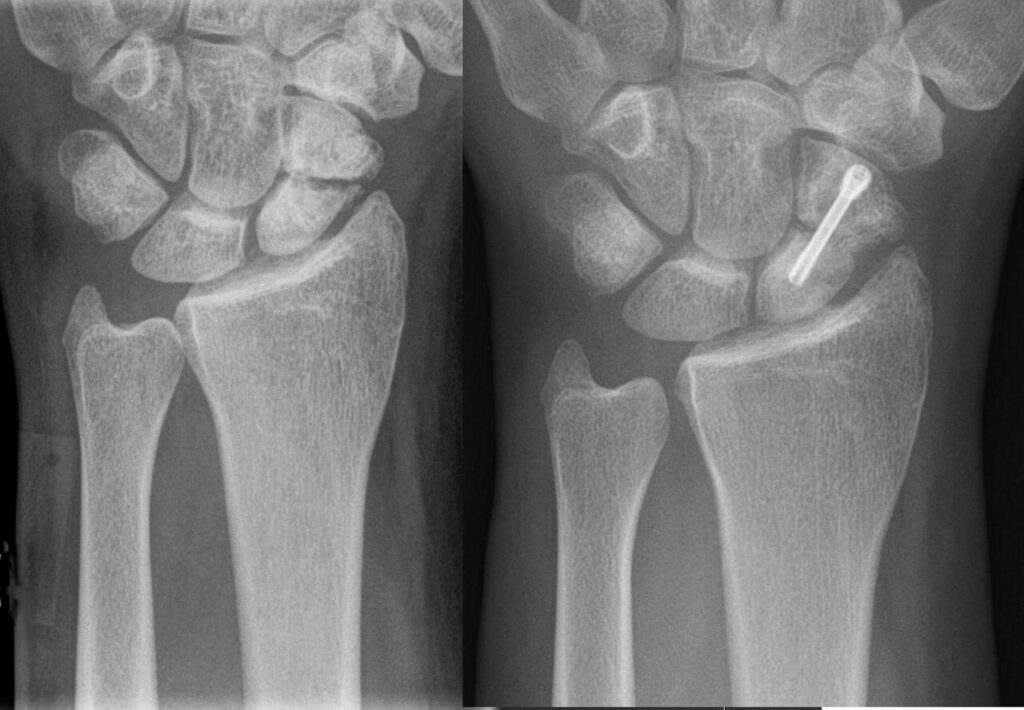
- What is the diagnosis, and why is the scaphoid prone to this problem?
- What investigations would you request?
- Outline your management.
- What happens if this is left untreated?
Answer
Diagnosis
- Established scaphoid waist nonunion
- Retrograde blood supply from dorsal branches of the radial artery entering the distal half
- Intra-articular fracture bathed in synovial fluid, with shear forces across the waist
- Missed or untreated fractures, displacement over 1 mm and proximal pole fractures raise the risk
Investigations
- Scaphoid series radiographs
- CT along the long axis of the scaphoid for displacement, bone loss and humpback deformity (lateral intrascaphoid angle over 35 degrees)
- Lateral radiograph for DISI, with a radiolunate angle over 15 degrees
- MRI, ideally with gadolinium, to assess proximal pole vascularity
Management
- Surgery is indicated in a symptomatic young patient
- Stable nonunion without deformity, headless compression screw with cancellous bone graft
- Humpback deformity, volar approach with a corticocancellous wedge graft to restore length and alignment (Fisk-Fernandez), then screw fixation
- Avascular proximal pole, vascularised graft such as the 1,2 intercompartmental supraretinacular artery graft or a medial femoral condyle free flap
- Cast until CT confirms union, usually at 10 to 12 weeks
Natural history if untreated
- Progressive scaphoid nonunion advanced collapse (SNAC)
- Stage I radial styloid arthritis, stage II scaphocapitate arthritis, stage III capitolunate arthritis
- Salvage with radial styloidectomy, proximal row carpectomy, four corner fusion or total wrist fusion
Related pages
Author Contributions
Orthofracs team
Reviewed by Professor Phong Tran, Head of Orthopaedic Surgery, Western Health. Last updated 10 October 2026.