
Immobilisation
- any child with neck pain, associated head or facial trauma, loss of consciousness & appropriate history e.g. high speed MVA must be considered for immobilisation
- in children younger than 6 years of age
- split mattress technique which allows for the thorax to sit higher than the occiput is important
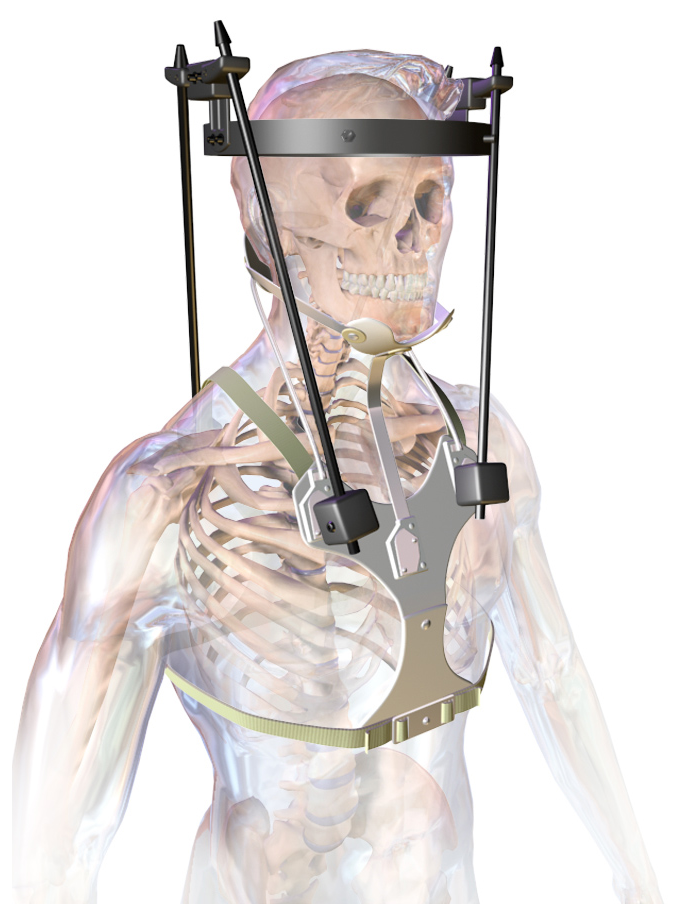
Halo Technique
- altered from the adult technique by using 4 pins anterolateral and 4 pins posterolateral
- child under 6 years of age
- have variable thickness to the skull & a CT scan may be helpful in the identification of adequate bonestock
- halo is held just below the greatest curvature anteriorly – typically above the eyebrows & 1 cm above the ears
- anterior pins are placed on the outer 2/3 of the orbit
- posterior pins are placed diagonal to the anterior & below the equator of the skull
- Young child – finger tighten
- Older child – 2lbs of torsion
- Adolescent – 4 lbs
- Adult – 6-8 lbs of torsion
- pins are secured to the halo & then to the appropriate vest or body cast
Many Complications of Halo
- Local pin care with daily iodine cleansing
- Superficial pin tract infections are managed with local wound care & PO antibiotics
- Severe infections are treated with pin removal & antibiotics
- Dural puncture is managed by removal of pins & 5 days of antibiotics
Reviewed by Professor Phong Tran, Head of Orthopaedic Surgery, Western Health. Last updated 10 October 2026.