
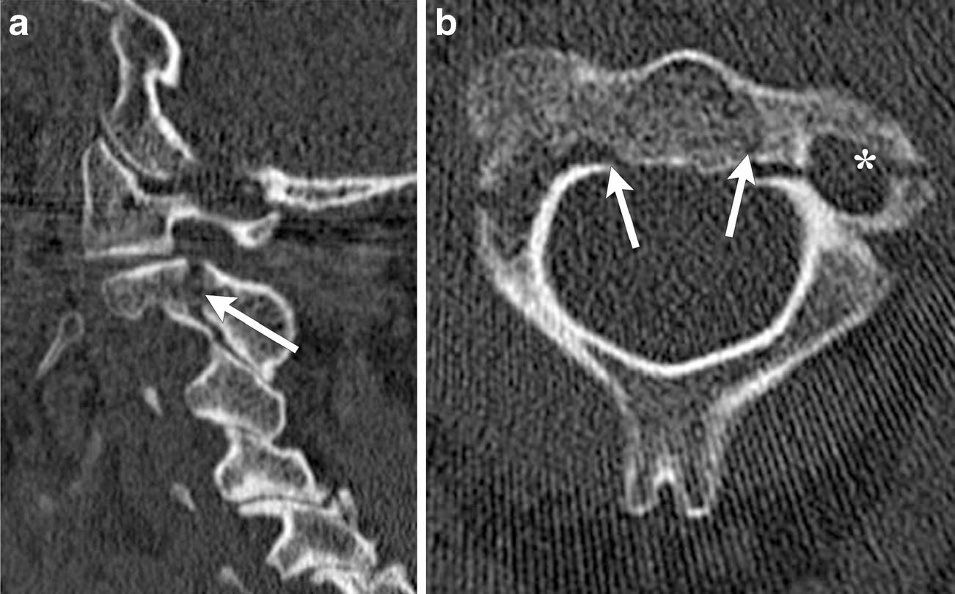
- If there is an ADI of >4.5 mm this implies ligamentous compromise
- Isolated transverse atlantoaxial ligament instability is rare in normal children
- However, it may occur frequently in Down’s syndrome, RA, Larsen syndrome, & bony dysplasia including mucopolysaccharidosis & various dwarfism
- Bony abnormality including Klippel Feil syndrome may be associated with instability
- Goldenhar & Apert syndrome may be associated with instability
History
- Above patients may be predisposed
- Cranial nerve, long tract signs & sphincter dysfunction, gait abnormality
Treatment
- acute injury should be immobilised in extension, followed by posterior fusion of C1 to C2 using a Halo postoperatively
- Chronic situation including Down’s wait up to 10 mm of displacement or SAC < 13 mm stabilisation is indicated
- If there is a < 10 mm ADI but the physical or history is suggestive of embarrassment then fuse
- Fusion is typically sublaminar BUT no sublaminar wires if the patient does not reduce
- If the Down’s ADI is greater than 4.5 mm should restrict the child from contact sport/trauma
Reviewed by Professor Phong Tran, Head of Orthopaedic Surgery, Western Health. Last updated 10 October 2026.