
Tibial stress fractures are the most common stress fracture, seen in runners, jumpers and military recruits. Posteromedial compression side fractures usually heal with activity modification, while anterior tension side fractures (the dreaded black line) are prone to nonunion and may need intramedullary nailing.
Epidemiology
- Most common Stress Fracture
- Accounts for >50% of Stress Fractures
- Common overuse injury in runners & jumpers
- Mid-tibial shaftStress Fractures
- Occur in dancers
- Occur in jumping athletes
Differential Diagnosis
- Shin Splints
- Exertional Compartment Syndrome
History
- Nocturnal pain
Examination
- Extremely painful focal area of tibia
- Provocative manoeuvres
- Pain on application of vibrating tuning fork
- Pain elicited on heel thump or >Hop Test”
- Pain with local ultrasound at 2.5 to 3 W/cm2
- Not recommended currently for initial diagnosis
- Common locations of Stress Fracture
- Children: Anterior proximal one third of tibia
- Adults: Junction of middle & distal third of tibia
Investigations
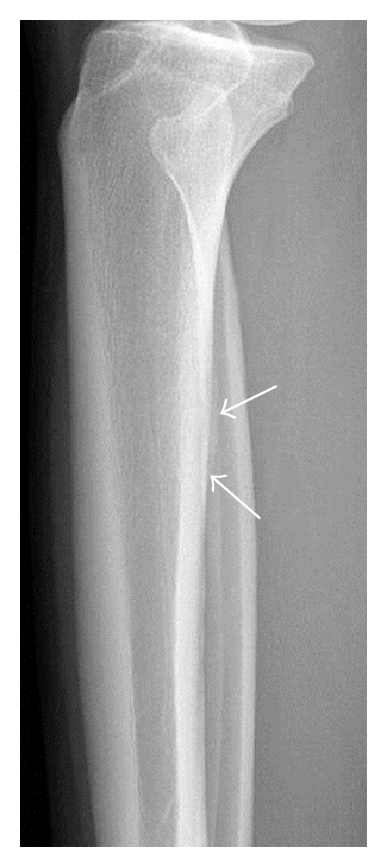
- X-ray with cone down view
- Horizontal lucency (dreaded black line)
- Transverse fracture through entire anterior shaft
- Seen more often in jumping sports
- Higher likelihood of nonunion
- Horizontal lucency (dreaded black line)
- Triple phase bone scan
- Focal hot spot at point of maximal tenderness
- Magnetic Resonance Imaging (MRI)
Management
- Consider Aircast splinting
- Cast mid-shaft fractures until pain-free
- Surgical repair indicated for delayed healing >6 months
Prognosis
- Anterior fracture with more non-union than anteromedial
Reviewed by Professor Phong Tran, Head of Orthopaedic Surgery, Western Health. Last updated 10 October 2026.