
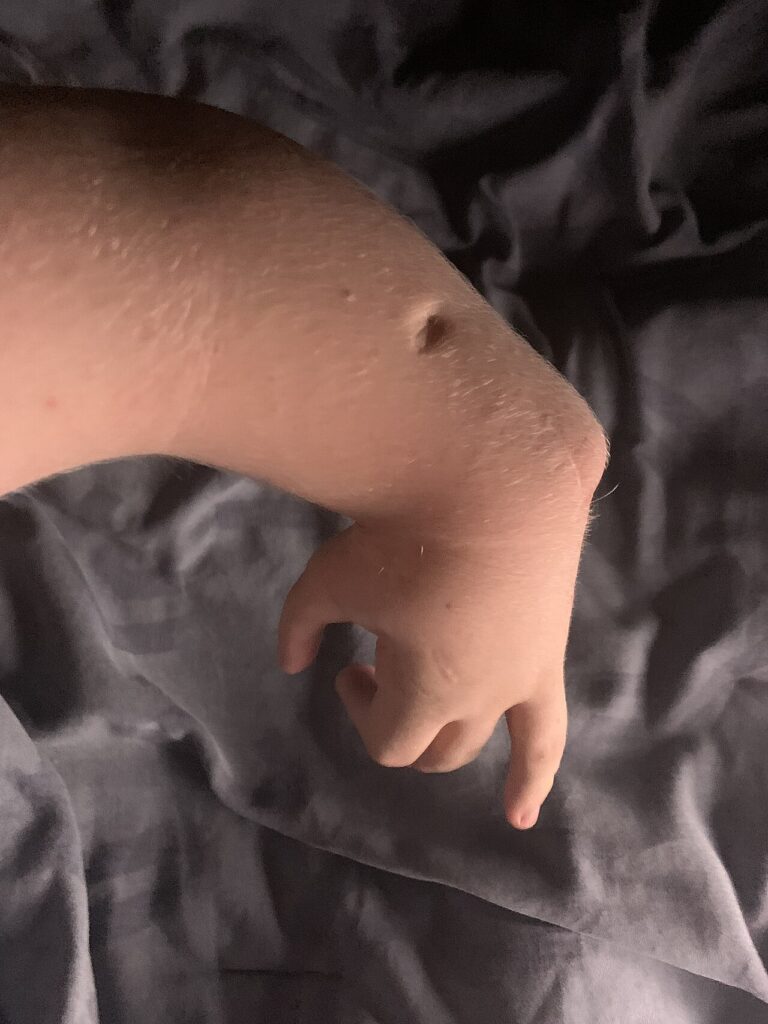
General
- occurs in between 1 in 30,000 & 1 in 100,000 live births
- underdevelopment, or aplasia, of the radius is universally associated with thumb hypoplasia, or absence, & hypoplasia or absence of the radial aspect of the carpus
- severity of the radial deficiency determines the extent of the associated deficiencies of the thumb, digits, ulna, & elbow
- spectrum of anatomic deficiency can range from mild radial deviation of the wrist & minimal thumb hypoplasia, to complete absence of the thumb & radius; camptodactyly of the index, long, & ring fingers; foreshortening of the ulna; & a stiff elbow
Classification
| Type | Description |
|---|---|
| I | ~ulna variance is positive as a result of the foreshortened distal radius ~minor foreshortening of the radius & a prominent distal ulna ~Although there is mild radial deviation of the wrist throughout life, problems with radioulnar incongruity such as triangular fibrocartilage tears, ulnocarpal impaction syndrome, & distal radioulnar joint pain or loss of motion, usually do not occur |
| II | ~both the proximal & distal radial physes have deficient growth, with more radial shortening & ulnar bowing ~limited proximal & distal radial physeal growth. As a consequence, the wrist is more radially deviated, & the ulna bows. The thumb hypoplasia is usually more significant, with more deficiency of the radial carpus |
| III | ~absence of the distal two-thirds of the radius ~wrist more severely deviated, & the hand has limited mechanical support ~ulna is thickened & bowed ~associated thumb & finger abnormalities of hypoplasia & camptodactyly are more common & severe |
| IV | *most common ~radius is completely absent ~ulna bowing is marked ~thumb is usually absent ~index, long, & even ring fingers are often involved ~elbow may have limited range of motion ~marked limitation of hand, wrist, & forearm function |
Pathogenesis
- Unknown
- Postulated that injury to the apical ectodermal ridge during upper limb development is the cause. Factors such as intrauterine compression, an inflammatory process, vascular insult, maternal drug exposure (thalidomide, insulin), & irradiation have all been raised as possible aetiological causes
- No known genetic cause except when associated with other congenital abnormalities
Associated Anomalies
- commonly associated with other congenital malformations
- Forty percent of patients with unilateral radial club hand & 27% of patients with bilateral have associated malformations
- Congenital cardiac
- Genitourinary
- Respiratory
- Skeletal
- neurologic problems
Pathoanatomy
- severity of the soft tissue loss parallels the skeletal deficiency
- preaxial muscles arise from the lateral epicondyle, & are normally innervated by the radial nerve
- radial wrist extensors & brachioradialis are absent or deficient
- pronator–flexor muscle mass is affected when its skeletal insertion sites are absent or hypoplastic
- neurovascular structures will be affected
- posterior interosseous & sensory branches of the radial nerve will be absent in a severe deformity
- radial artery is usually absent
- ulnar nerve & artery are usually present & unaffected
- median nerve is usually present & serves as a neural supply to the hand with the ulnar nerve
Treatment
Address
- unstable wrist with lack of support for the hand
- digital weakness secondary to radially deviated wrist
- intrinsic digital weakness & deformity
- thumb hypoplasia or aplasia that results in lack of opposition
- foreshortened ulna
Complications
- Recurrent deformity
- Premature closure of the distal ulnar physis
- Physeal arrest is more common with centralization procedures
Reviewed by Professor Phong Tran, Head of Orthopaedic Surgery, Western Health. Last updated 10 October 2026.