
Definition
- a benign disease of unknown aetiology characterised by
- back pain
- disc space narrowing
- resolution of symptoms with rest
Incidence
- rare
- average age 3 yo
Aetiology
- unknown
- ? Is it infective
- ? Is it non-infective
History
- Younger children
- Gradual onset of 2-4 weeks
- may be preceded by URTI etc
- Irritable, limping & refusal to sit or stand
- Abdominal pain
- Back pain
Examination
- Fever > 50%
- Look
- Decreased lumbar lordosis
- Feel
- Lumbar tenderness
- Move
- Hip irritable in extension – psoas stretch
- Positive SLR
- Positive ↓ in popliteal angles secondary to hamstring spasm
- Paravertebral muscle spasm
Investigation
- Bloods
- ESR usually up
- WCC usually normal
- Blood cultures
- +ve in ~ 50%
- after 6 weeks of onset of symptoms organisms do not appear to be isolated from blood cultures
- due to rapid destruction of bacteria once the end plates are breached
- +ve in ~ 50%
- X-ray
- early
- normal
- later
- disc narrowing
- progressive end plate lesions with erosion into the vertebral body
- latest
- fusion rare, usually very little residual disc narrowing
- early
- Bonescan
- 72% positive
- CT
- show the bony detail
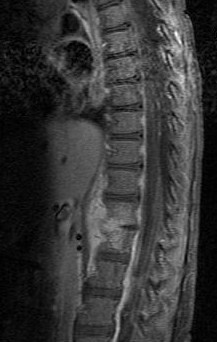
- MRI
- if neurologic concerns
Treatment
- Rest
- until no pain or limitation of motion, & until ESR normal
- Antibiotics
- indicated if febrile
- +ve blood cultures
- +ve biopsy
- IV until patient comfortable, then oral for 3 more weeks
Prognosis
- good- spontaneous recovery is almost the rule
Reviewed by Professor Phong Tran, Head of Orthopaedic Surgery, Western Health. Last updated 10 October 2026.