
Definition
- Spondylolysis is a defect in the pars interarticularis
- Spondylolisthesis is forward slip of one vertebra on the one below
Classification
Wiltse
| Type | Description |
|---|---|
| I | Dysplastic, congenital deficiency of L5 to S1 facets with intact pars |
| II | Isthmic, pars lesion from stress fracture or elongation |
| III to VI | Degenerative, traumatic, pathological and iatrogenic, mostly adult |
Original publication Wiltse LL, Newman PH, Macnab I. Classification of spondylolisis and spondylolisthesis. Clin Orthop Relat Res. 1976(117):23-9.
Meyerding
| Grade | Slip |
|---|---|
| 1 | 1 to 25% |
| 2 | 26 to 50% |
| 3 | 51 to 75% |
| 4 | 76 to 100% |
| 5 | More than 100%, spondyloptosis |
Key reference (original not indexed in PubMed) Koslosky E, Gendelberg D. Classification in Brief: The Meyerding Classification System of Spondylolisthesis. Clin Orthop Relat Res. 2020;478(5):1125-1130.
Epidemiology
- Isthmic spondylolysis in about 6% of the population by adulthood
- Most common at L5
- Higher in gymnasts, divers, fast bowlers and weightlifters
Clinical Features
- Activity related low back pain with extension
- Stork test reproduces pain on single leg extension
- Hamstring tightness
- Phalen Dickson sign, crouched gait with flexed knees and hips in high grade slips
- Cauda equina symptoms more likely in dysplastic slips with intact posterior arch
Investigations
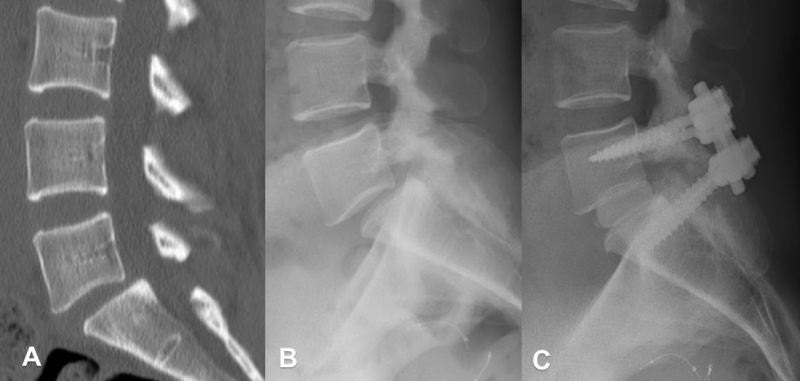
- Standing lateral radiograph for slip grade and slip angle
- Oblique views may show the Scottie dog collar
- MRI detects early stress reaction without radiation
- CT to assess pars healing
Management
- Acute spondylolysis, activity restriction with or without bracing
- Early unilateral lesions often heal
- Low grade slips, physiotherapy and observation for progression
- Pars repair for symptomatic lysis without slip or disc degeneration
- Fusion in situ for persistent pain, progression or slip over 50%
- High grade slips, L4 to S1 fusion with or without reduction
Complications
- L5 nerve root injury with reduction of high grade slips
- Pseudarthrosis and slip progression after fusion
- Progression risk higher in young girls, dysplastic slips and high slip angle
Reviewed by Professor Phong Tran, Head of Orthopaedic Surgery, Western Health. Last updated 10 October 2026.