
Definition
- Fracture of the distal third of the radius with dislocation of the DRUJ
- Described by Galeazzi in 1934
- Called the fracture of necessity because adults need surgery
Aetiology
- Fall on outstretched hand with axial load and forearm rotation
Anatomy
- Brachioradialis, pronator quadratus and thumb extensors deform the fracture
- Rettig and Raskin showed fractures within 7.5 cm of the wrist joint are more often unstable at the DRUJ
Clinical Features
- Painful deformed forearm
- Prominent ulnar head at the wrist
Investigations
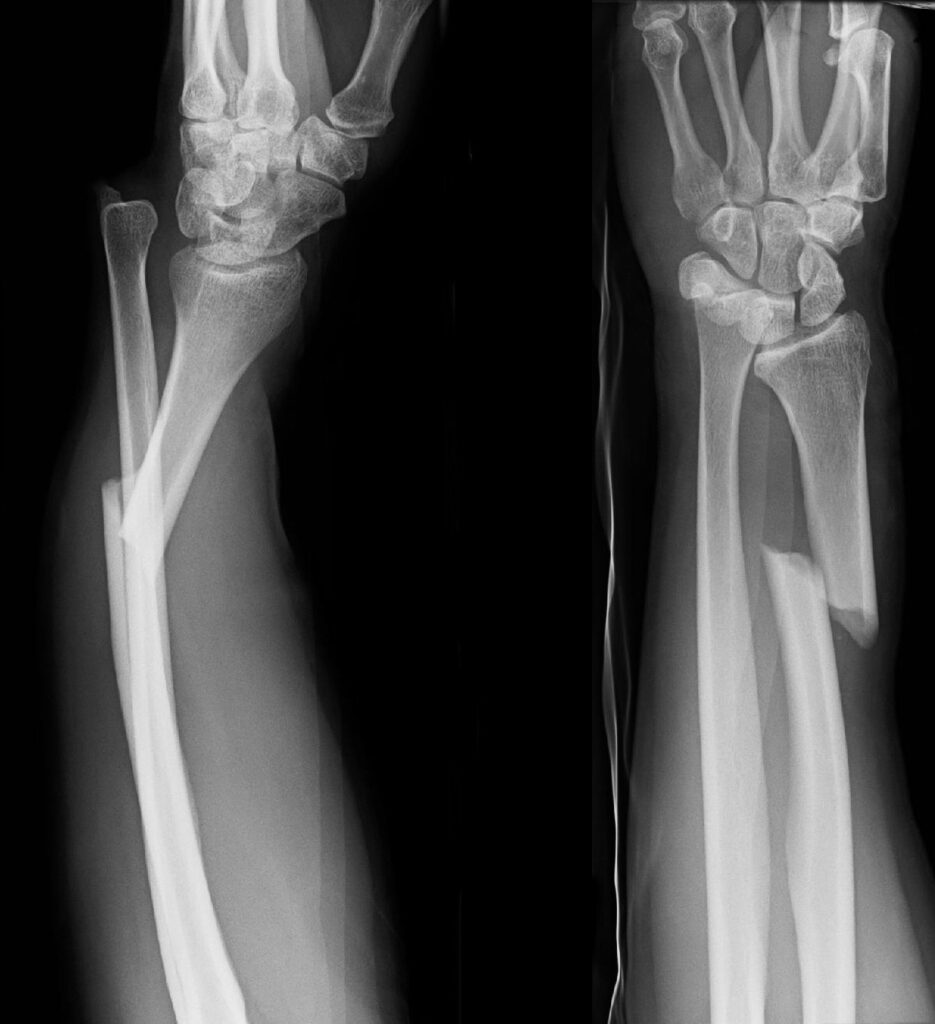
- AP and lateral of the forearm including elbow and wrist
- Widened DRUJ on AP and dorsal ulnar displacement on lateral
- Ulnar styloid base fracture suggests DRUJ instability
- Radial shortening over 5 mm suggests DRUJ disruption
Management
Adults
- ORIF of the radius with compression plate through a volar Henry approach
- Assess DRUJ stability after fixation in all rotations
- Stable DRUJ needs no further treatment
- Reducible unstable DRUJ is pinned or casted in supination for about 6 weeks
- Fix a large ulnar styloid base fragment
- Irreducible DRUJ needs open reduction, often ECU interposition
Children
- Closed reduction and above elbow cast, usually in supination
- Accurate radial reduction restores the DRUJ
- Galeazzi equivalent is distal ulnar physeal separation with radius fracture
Complications
- Chronic DRUJ instability
- Loss of pronation and supination
- Malunion and nonunion
- Missed DRUJ dislocation
- Posterior interosseous nerve injury with a dorsal approach
Reviewed by Professor Phong Tran, Head of Orthopaedic Surgery, Western Health. Last updated 10 October 2026.