
Definition
- Also called nursemaid’s elbow or radial head subluxation
- Annular ligament slips proximally over the radial head into the radiocapitellar joint
- Soft tissue subluxation, the radial head does not truly dislocate
Epidemiology
- Commonest elbow injury in young children
- Ages 1 to 4 years, peak 2 to 3 years
- More common in girls and on the left
- Recurrence common until about 5 years, when the radial head enlarges and ligament strengthens
Aetiology
- Sudden longitudinal pull on the extended, pronated arm, such as lifting or swinging by the hand
- No clear pull history in some cases, especially infants
Clinical Features
- Child refuses to use the arm, held by the side with elbow slightly flexed and forearm pronated
- Pain on attempted supination with radial head tenderness
Investigations
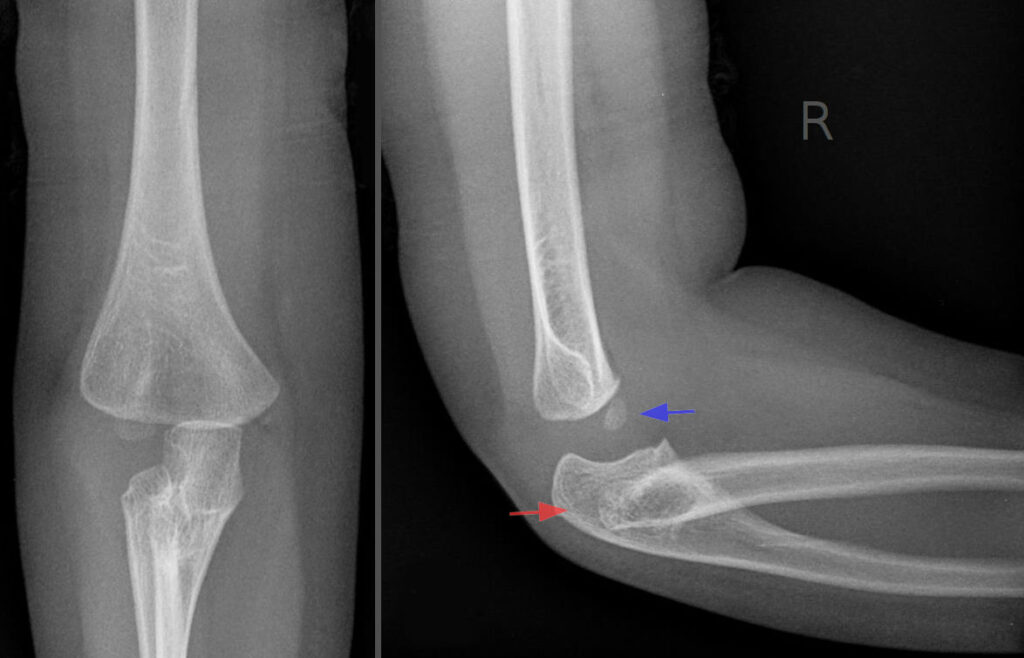
- No radiographs needed with a consistent history and examination
- X-ray for swelling, bruising, a fall, direct trauma or tenderness away from the radial head
- X-ray if the arm is not used after reduction
- Radiographs of a pulled elbow are normal
Management
- Supination then full flexion, with the thumb over the radial head
- Hyperpronation with the elbow flexed is at least as successful and may hurt less
- A palpable click over the radial head confirms reduction
- Most children use the arm within 10 to 15 minutes
- Persistent non-use needs radiographs to exclude fracture
- Advise parents against lifting or swinging the child by the hand
Differential Diagnosis
- Isolated radial head dislocation is a Monteggia lesion until proven otherwise
- Radial neck and shaft line passes through the capitellum on every view
- A missed Monteggia lesion becomes a chronic dislocation, much harder to treat
- Congenital dislocation is posterior or posterolateral, often bilateral and painless, linked to nail patella syndrome
- Congenital form has a dome-shaped radial head, hypoplastic capitellum and long radius
- Congenital form is irreducible, left alone, with radial head excision at maturity for pain
- Supracondylar, lateral condyle, radial neck and clavicle fractures, and septic arthritis
Reviewed by Professor Phong Tran, Head of Orthopaedic Surgery, Western Health. Last updated 10 October 2026.