
Overview
- Failures of formation in first trimester limb development
- Transverse, such as congenital below elbow amputation
- Longitudinal, such as radial or ulnar longitudinal deficiency
- OMT classification is now standard
- Radial deficiency needs cardiac, renal and haematological assessment
- Function before appearance, with therapy, splints, prostheses, centralisation and pollicisation
Pathology
- Limb bud appears at day 26 and development is largely complete by week 8
- AER drives proximodistal growth through FGF, and its loss causes transverse truncation
- ZPA patterns the radioulnar axis through sonic hedgehog
- Excess ZPA activity gives mirror hand and preaxial polydactyly
- Dorsal Wnt7a and Lmx1b set dorsoventral patterning, lost in nail-patella syndrome
Classification
- Swanson (IFSSH) groups by presumed embryological failure, such as formation, differentiation and duplication
- OMT has replaced Swanson, dividing malformations, deformations, dysplasias and syndromes
Bayne and Klug
| Type | Description |
|---|---|
| 0 | Normal radius with carpal or thumb anomaly |
| 1 | Short distal radius |
| 2 | Hypoplastic radius |
| 3 | Partial absence |
| 4 | Complete absence, the commonest |
Original publication Bayne LG, Klug MS. Long-term review of the surgical treatment of radial deficiencies. J Hand Surg Am. 1987;12(2):169-79.
Investigations
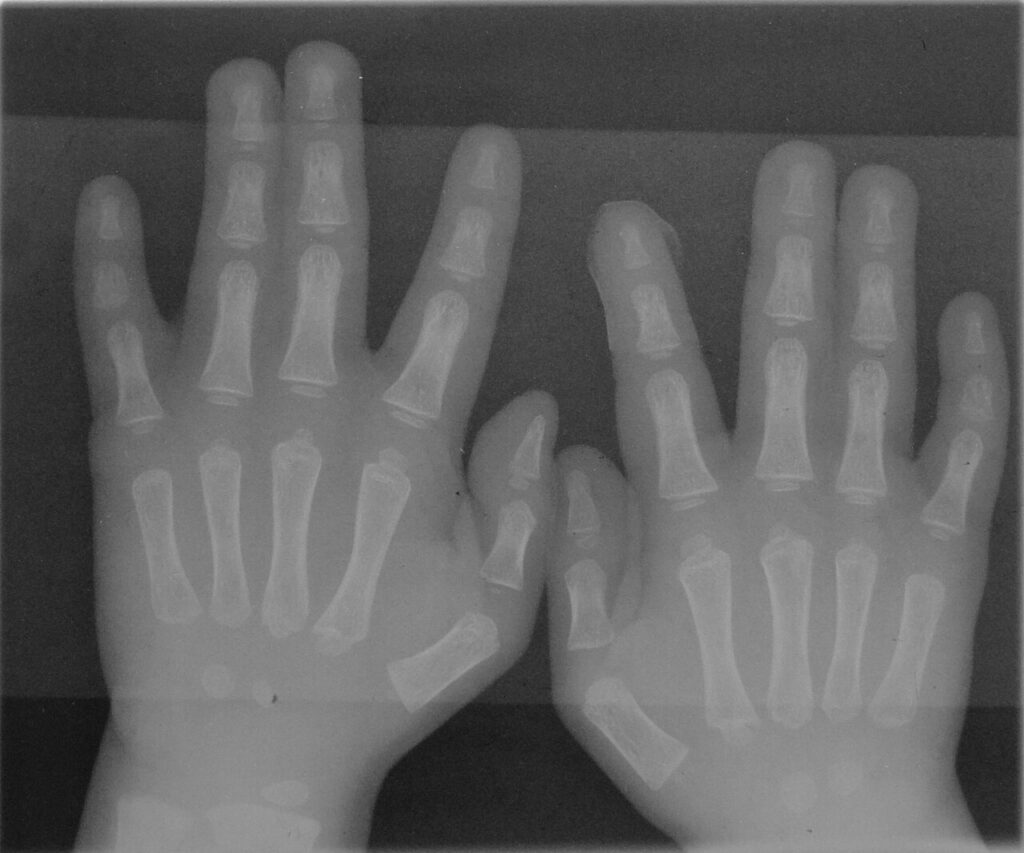
- Screen radial deficiency for VACTERL, Holt-Oram, TAR and Fanconi anaemia
- Fanconi needs chromosomal breakage testing
- Renal ultrasound, echocardiogram and FBC
Management
- Radial deficiency starts with stretching and splinting
- Centralisation or radialisation in infancy needs enough elbow flexion for the hand to reach the mouth
- Preliminary distraction eases soft tissues, recurrence is common
- Pollicisation for absent or unstable thumbs
- Ulnar deficiency has a stable wrist, so surgery targets thumb web, syndactyly and rotation
- Transverse deficiency is commonest at the proximal forearm, with nubbins suggesting symbrachydactyly
- Early prostheses encourage bimanual use, though rejection is high
Reviewed by Professor Phong Tran, Head of Orthopaedic Surgery, Western Health. Last updated 10 October 2026.