
Definition
- Rare hereditary disorder
- Deficiency of Homogentisic Acid Oxidase » accumulation of Homogentisic Acid
- Memory aid “ONC = HOG”
Characterised by
- Homogentisic acid in urine
- Dark pigmentation of connective tissues – Ochronosis
- Calcification of hyaline & fibrocartilage – Chondrocalcinosis
Epidemiology
- Autosomal recessive disorder
- Usually presents with symptoms in 4th decade
Pathogenesis
- Deletion of Homogentisic Acid Oxidase in the pathway concerned with metabolism of the amino acids Phenylalanine & Tyrosine
- Accumulation of Homogentisic Acid occurs
- Excreted in urine
- Oxidisation (when urine left standing) & Alkalinisation (hence name “alkaptonuria”) of Homogentisic Acid turns urine black
- Homogentisic Acid retained in body is deposited in
- Articular & fibrocartilage
- Skin
- Sclerae
- Pigment causes the collagen fibres to lose normal resilience
- Becomes brittle & fibrillated
- Degenerative changes in joints follow
- May have pyrophosphate crystals in joint
- Loose body formation not uncommon
Clinical Features
- The first complaint is back pain & stiffness with deposition of pigment in the intervertebral discs & later calcification
- May resemble Ankylosing Spondylitis but sacroiliac joints spared
- Then large joint disease follows with classic degenerative changes & loose bodies frequent
- Chondrocalcinosis common
- Deposition of pigment in sclerae, pinna of ear & dark sweat (staining clothes) is commonly seen
Radiographically
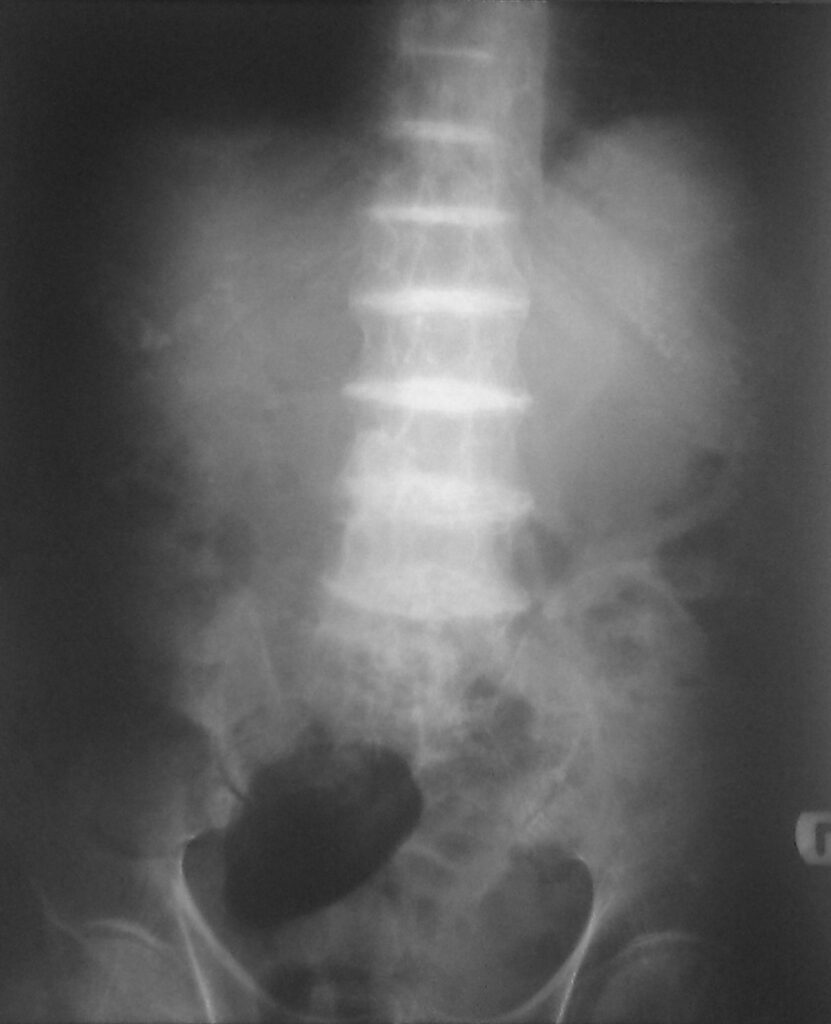
- See calcification & narrowing of intervertebral discs & surrounding osteoporosis
- Severe osteoarthritis in peripheral joints with chondrocalcinosis
Treatment
- No treatment for the metabolic disorder but may need surgery for arthritic joints
Reviewed by Professor Phong Tran, Head of Orthopaedic Surgery, Western Health. Last updated 10 October 2026.