
Indications
- Limited exposures in high risk patients
- Abscess drainage
- Vertebral body biopsy
- Limited anterior spinal fusion
- Anterolateral decompression of spinal cord
Position
- Prone
- Bolsters positioned longitudinally on each side of rib cage to allow for chest expansion
Landmarks
- Spinous processes
- II & needle in spinous processes
- Lateral X-ray
Incision
- 10 cm Curved longitudinal incision, 8cm lateral to spinous processes
Superficial Dissection
- incise subcutaneous fat & fascia
- split trapezius muscle fibres along the line of its fibres
- cutting down to expose the rib
Deep Dissection
- dissect off the muscle attachments to the rib subperiosteally using a periosteal elevator
- Divide the rib 6-8 cm from the midline
- Lift the rib & detach any further muscles & the costotransverse ligament
- Twist the rib’s medial end to complete the resection
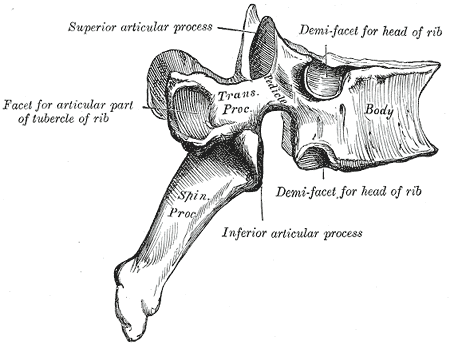
- Transverse process
- Reflect muscle attachments off the transverse process
- Divide the process at its junction with the lamina & pedicle & remove it
- Retropleural space
- Careful blunt dissection with fingers to enter the retropleural space by removing parietal pleura from vertebral body
- Exposing vertebral body & disc space
Dangers
- Nerves
- Vessels
- Segmental intercostal arteries
- Lungs & pleura
- pneumothorax
Reviewed by Professor Phong Tran, Head of Orthopaedic Surgery, Western Health. Last updated 10 October 2026.