
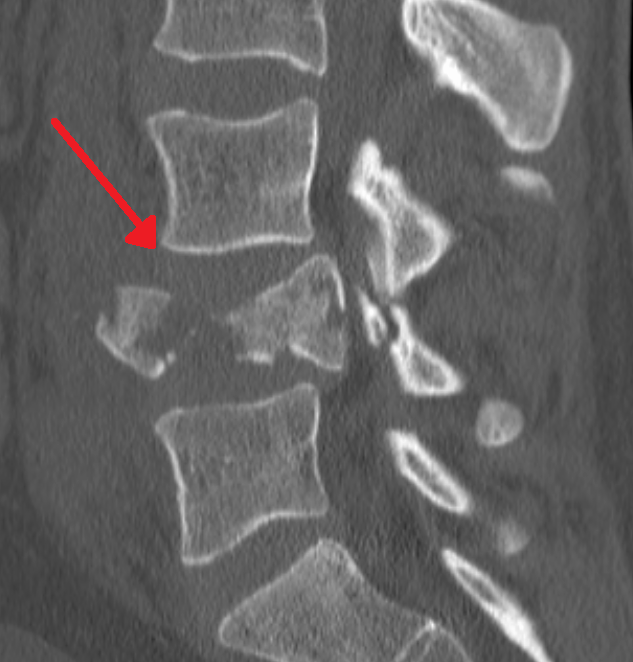
Overview
- Commonest at the thoracolumbar junction, between stiff thoracic and mobile lumbar spine
- ATLS assessment with whole spine imaging, as noncontiguous injuries are common
- AO Spine grades morphology, neurology and modifiers, TLICS guides treatment
- Stable burst fractures without deficit mobilise early, with or without a brace
- Surgery for deficit, posterior ligament disruption, translation or progressive deformity
Western Health Orthopaedic Registrar presentation – Thoracolumbar Spine Trauma by Dr Amy Gibbens
Classification
Denis
- Anterior, middle and posterior columns, with injury to two or more implying instability
AO Spine
| Type | Description |
|---|---|
| A | Compression. A3 incomplete burst of one endplate, A4 complete burst of both |
| B | Tension band failure. B1 bony Chance, B3 anterior hyperextension injury |
| C | Displacement or translation |
- Neurology N0 to N4 and NX, with posterior ligament and comorbidity modifiers
TLICS
Scores morphology, neurology and posterior ligamentous complex integrity
| Total score | Management |
|---|---|
| 3 or less | Non-operative |
| 4 | Indeterminate |
| 5 or more | Surgery |
Denis sacral zones
| Zone | Description |
|---|---|
| I | Lateral to the foramina, occasional L5 root injury |
| II | Through the foramina, sacral root injury |
| III | Medial into the canal, highest rate of bowel, bladder and sexual dysfunction |
Original publication Denis F, Davis S, Comfort T. Sacral fractures: an important problem. Retrospective analysis of 236 cases. Clin Orthop Relat Res. 1988;227:67-81.
Management
- Intact burst fractures with intact posterior ligaments do as well non-operatively as with fusion
- Bracing shows no clear benefit over mobilisation without a brace
- Canal compromise alone is no indication, as retropulsed fragments remodel
- Surgery for deficit, ligamentous disruption, progressive kyphosis or translation
- Bony Chance fractures may heal in a hyperextension cast or brace
- Ligamentous Chance injuries need posterior compression instrumentation and fusion
- Seat belt sign suggests hollow viscus injury
- Keep MAP above about 85 mmHg, without routine high-dose methylprednisolone
- U and H sacral fractures cause spinopelvic dissociation, treated with lumbopelvic fixation or iliosacral screws
Reviewed by Professor Phong Tran, Head of Orthopaedic Surgery, Western Health. Last updated 10 October 2026.