
Definition
- Fracture of the medial, lateral and posterior malleoli
- Posterior malleolus is the posterior lip of the distal tibial plafond
Aetiology
- Rotational injury, most often SER IV or PER IV Lauge-Hansen patterns
- Posterior fragment avulsed by the posterior inferior tibiofibular ligament (PITFL)
Anatomy
- PITFL attaches to the posterior malleolus, so the fragment carries syndesmotic stability
- Posterolateral fragment is also called the Volkmann fragment
Classification
Haraguchi (CT based)
| Type | Description |
|---|---|
| 1 | Posterolateral oblique |
| 2 | Medial extension |
| 3 | Small shell fragment |
Original publication Haraguchi N, Haruyama H, Toga H, Kato F. Pathoanatomy of posterior malleolar fractures of the ankle. J Bone Joint Surg Am. 2006;88(5):1085-92.
Bartonicek
- Five types based on fragment shape, fibular notch involvement and tibial stability
Clinical Features
- Marked swelling and possible posterior talar subluxation or dislocation
- Fracture dislocations need urgent reduction to protect skin
Investigations
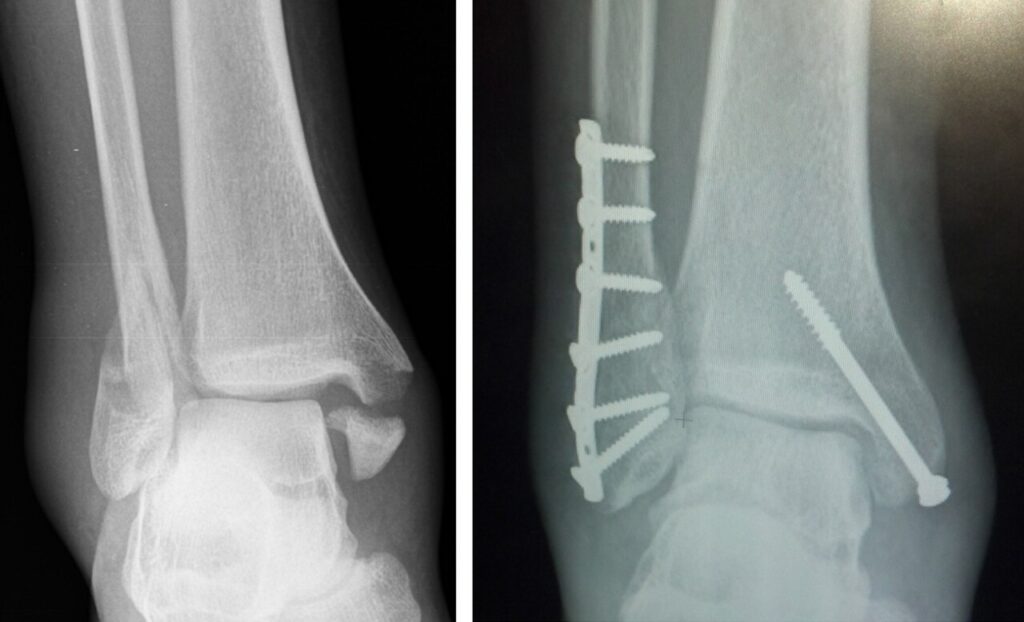
- AP, lateral and mortise radiographs
- Lateral view underestimates fragment size
- CT recommended to define fragment morphology and plan approach
Management
- Closed reduction and backslab, then ORIF when soft tissues allow
- External fixator for unstable dislocation or poor skin
- Posterior fragment fixation indicated for talar subluxation or articular step over 2 mm
- The older 25 to 33% fragment size rule is less favoured now
- Fixing the posterior malleolus restores PITFL tension and may avoid a syndesmotic screw
- Posterolateral approach between peroneals and FHL allows fibula and posterior malleolus fixation
- Posteromedial approach for fragments with medial extension
- Anterior to posterior lag screws are an option for undisplaced fragments
Complications
- Post-traumatic arthritis, more frequent than in bimalleolar fractures
- Wound breakdown and infection
- Malreduction of the posterior fragment and syndesmosis
- Sural nerve injury with the posterolateral approach
Prognosis
- Worse functional outcomes than bimalleolar fractures
- Anatomic reduction of the articular surface and syndesmosis gives the best results
Reviewed by Professor Phong Tran, Head of Orthopaedic Surgery, Western Health. Last updated 10 October 2026.