
Definition
- Fracture of both the medial and lateral malleoli, disrupting both sides of the ankle ring
- Bimalleolar equivalent is a lateral malleolar fracture with deltoid ligament rupture
Aetiology
- Rotational injury, most often supination external rotation (Lauge-Hansen SER IV)
- Pronation external rotation and pronation abduction patterns also produce bimalleolar injuries
Classification
Weber
Based on fibular fracture level relative to the syndesmosis
| Type | Fibular fracture level |
|---|---|
| A | Below the syndesmosis |
| B | At the syndesmosis |
| C | Above the syndesmosis |
Lauge-Hansen
- Foot position then deforming force, giving SER, SA, PER and PA patterns
- Predicts the sequence of ligament and bone failure
Clinical Features
- Pain, swelling and bruising on both sides of the ankle
- Check skin for tenting or blistering and assess neurovascular status
Investigations
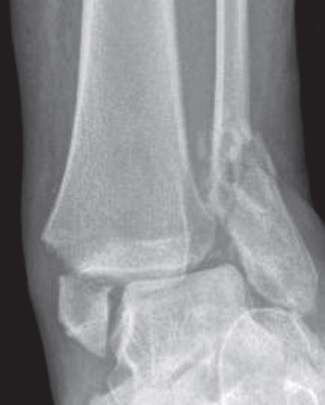
- AP, lateral and mortise radiographs of the ankle
- Medial clear space widening over 4 mm suggests deltoid incompetence
- Full length tibia films if a proximal fibular fracture (Maisonneuve) is suspected
- CT if a posterior malleolar fragment is seen or suspected
Management
- Urgent closed reduction and backslab for any talar shift or skin compromise
- Unstable injury, so ORIF is standard in fit patients
- Lateral malleolus fixed with lag screw and neutralisation plate, or posterior antiglide plate
- Medial malleolus fixed with two partially threaded cancellous screws or tension band wiring
- Syndesmosis stressed intraoperatively after bony fixation
- AIM trial showed close contact casting matched ORIF function at 6 months in patients over 60
- Delay surgery until swelling settles if skin wrinkles are absent
Complications
- Wound breakdown and infection, higher in diabetes, smokers and the elderly
- Malunion with fibular shortening or rotation leads to talar shift
- Post-traumatic arthritis
- Symptomatic hardware
- DVT
Prognosis
- Accurate restoration of the mortise gives good results in most patients
- Talar shift of 1 mm reduces tibiotalar contact area by about 40% (Ramsey and Hamilton)
Reviewed by Professor Phong Tran, Head of Orthopaedic Surgery, Western Health. Last updated 10 October 2026.