
Anatomy
- Load bearing through the Meniscus
- Extension
- at least 50% of the compressive load of the knee joint
- Flexion
- approx 85% of the load is transmitted in 90° flexion.
- Post Total Meniscectomy
- meniscectomised knee the contact area is reduced approx 50%
- Partial meniscectomy also ↑ the contact pressures
- Extension
- Shock absorption
- menisci may attenuate the intermittent shock waves generated by impulse loading during gait
- shock absorbing capacity of normal knees is ~ 20% higher than in meniscectomised knees.
- The ability of a system to absorb shock has been implicated in development of Osteoarthritis
- Knee joint stability
- meniscectomy alone may not seriously affect stability.
- However, in associated with ACL tears, meniscectomy ↑ anterior laxity of the knee
- Lubrication
- Proprioception
- type 1 & type 2 nerve endings in the anterior & posterior horns of the menisci
Epidemiology
- 1000 meniscal injuries
- Medial
- 70% were medial
- Average age
- 39 years medial
- 30 years lateral meniscus injuries
- Medial
- Mechanism of Injury
- Young
- Occur only when weight is being taken,
- knee is flexed & there is a twisting strain,
- Older patients
- may result from minor force
- Young
History
- Acute history of injury
- localised pain
- ± locking
- locked knee will flex but not extend fully
- history of unlocking is characteristic of a mechanical block
- Local signs will depend on
- time the joint is examined
- whether or not it is still locked (usually locked in 10° – 20° flexion)
- Medial or lateral joint line tenderness
- clicking with knee rotation in full flexion
Investigations
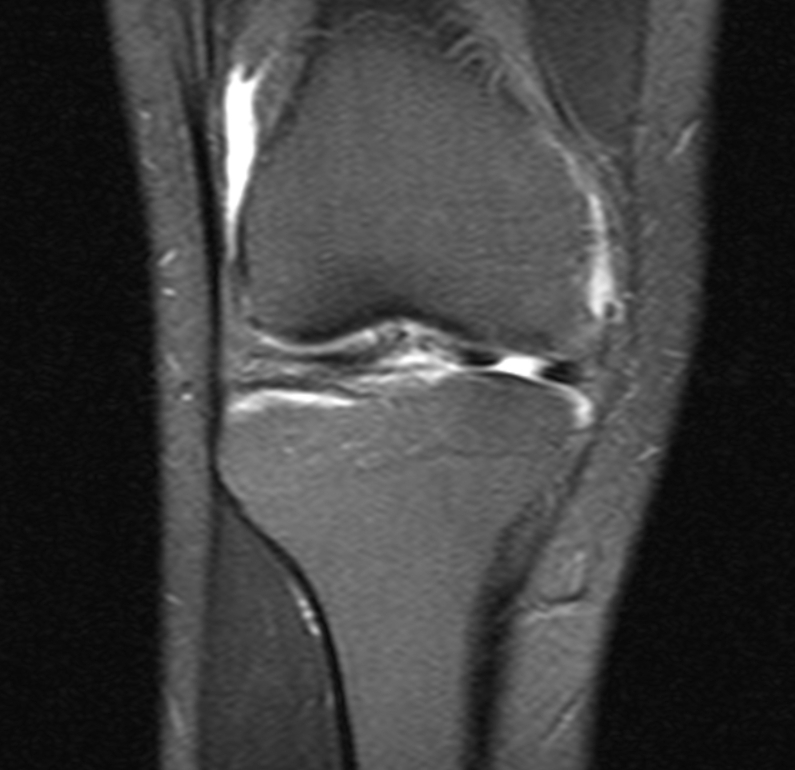
- MRI
- sensitivity 69-88%
- Specificity 57-84%
- Accuracy 72-89%
Classification
| Type | Description |
|---|---|
| 1 | Complete |
| 2 | Incomplete |
| 3 | Wrisberg type with a mobile posterior horn due to a lack of any posterior menisco-tibial attachment |
Discoid Meniscus
- In the foetus the meniscus is disc like & if this shape persists symptoms are likely
- Characteristic clunk at 110° of flexion & at 10° as the knee is being extended
Differential Diagnosis
- Loose bodies
- Recurrent dislocation of the patella
- Ligament injuries
- Chondromalacia patellae
Treatment
Non-operative
- restrict activity
Operative
- Options
- arthroscopic partial meniscectomy
- Discoid meniscus
- excise the central portion of the disc for Types I & II
- resect the meniscus if Type III (Wrisberg Type)
- Meniscal cysts
- need to address pathology in the joint & not just the cyst as excision of the cyst alone is likely to recur
- Meniscal transplantation- experimental
Meniscal Repair
- Blood supply
- age dependent
- in the adult the periph 3mm as well as the anterior & posterior horns are well vascularised
- Blood supply originates from the lateral + medial geniculate arteries (sup & inf)- branches
- give rise to a perimeniscal capillary plexus in the synovial & capsular tissue
- supplies the meniscus on its peripheral attachment to the joint capsule
- degree of vascular penetration is 10-30% of medial & 10-25% of lateral meniscus.
- repair
- should be reserved for traumatic tears in the vascular region of the meniscus
- within 3mm of periphery = vascular (= red- red tears)
- 3-5 mm from periphery = grey zone (= red- white tears)
- > 5mm from periphery = avascular (= white- white tears)
- Healing
- similar to other connective tissue
- exudation,
- organisation,
- vascularisation cellular proliferation
- remodelling
- following injury there is formation of a fibrin clot rich is inflammatory cells.
- Vessels from the perimeniscal capillary plexus proliferate into this fibrin scaffold, followed by mesenchymal cell proliferation forming a cellular fibrovascular scar.
- Modulation of this scar tissue into normal appearing fibrocartilage requires several months
- Approx 80% of repairable menisci are found in knees with an acute or chronic tear of the ACL
- thus repair of the meniscus is linked to the management of the ACL tear
- NB risk of injury to peroneal n in lateral meniscus repair, saphenous n in medial repair
- similar to other connective tissue
- Aftercare
- 6 weeks
- maximal protection to allow initial healing
- Minimal touch down WB 6 weeks in hinged splint, initially locked
- Isometric Q+H setting exercises begun immediately post op
- limited ROM 30-70° at 2 weeks
- remove splint 4 weeks, ↑ stretching exercises between 4-6 weeks
- from 6 weeks WB ↑ to FWB by 8 weeks
- Low impact activity from 3 months
- subsequent 6 mth
- protection from vigorous stresses to allow for maturation of the healing collagen tissue
- Full activity at 6 mths
- Results of meniscal suture
- 62% heal, 17% heal incompletely & 21% do not heal
- 92% are clinically stable
- 80% return to active sport
- NB: 30-40% failure rate in 5 years in meniscal repair in knees that are ACL deficient- therefore need to reconstruct ACL to protect meniscal repair
- the success rate in stable knees is ~ 90% at 9 years
Reviewed by Professor Phong Tran, Head of Orthopaedic Surgery, Western Health. Last updated 10 October 2026.