
Definition
- Enlarged bursa in the popliteal space, usually due to a semimembranosus or gastrocnemius bursa enlargement.
- Described by Baker in 1877.
Epidemiology
- A third to a half of patients are children.
Pathology
- Most often derived from the bursa under the medial head of gastrocnemius or the double bursa of semimembranosus
- this is located between the SM tendon & the medial tibial condyle, & between the SM tendon & the medial head of gastrocnemius.
- The cysts can be produced by herniation of the synovial membrane through the posterior part of the capsule or by escape of fluid from the knee into the two bursae which normally communicate with it (SM & medial head of gastroc).
- Intraarticular pathology is found in around 50% of patients with cysts.
- In children, the cyst infrequently communicates with the knee joint, & intra-articular pathology is rare.
- Dissection or rupture of the cyst may cause acute pain & swelling, & rarely may cause a compartment syndrome.
- Pressure from the cyst may cause a popliteal vein thrombosis.
Examination
- Pain & swelling.
- May be associated effusion.
- The mass transilluminates.
- If there is any dilemma the joint can be aspirated; injection of steroid is often curative.
Investigations
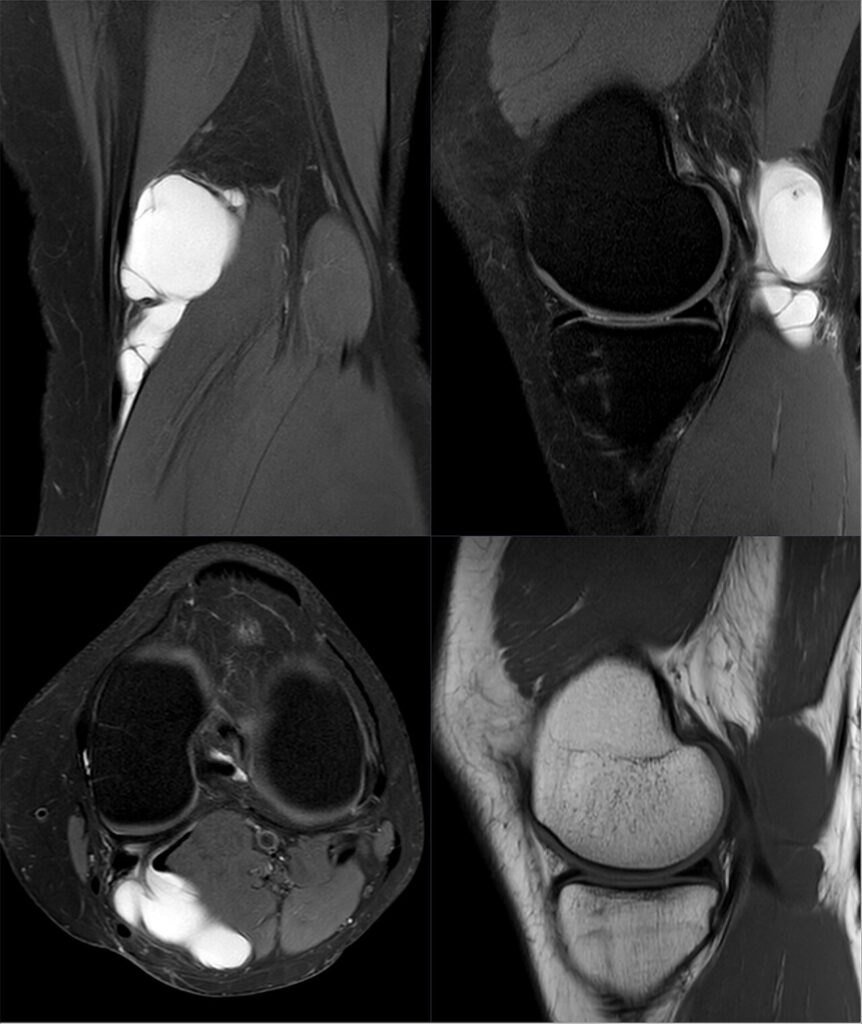
- MRI & US demonstrate a cystic lesion.
Treatment
Non-operative
- Steroid injection
Operative
- Arthroscopy
- If there is a posterior horn meniscal cyst or lesion, debridement of this lesion will normally cure the problem.
- Open
- If there is no demonstrated communication with the cyst or no intra-articular pathology, one can go on to open excision of the cyst, via a posteromedial approach.
- The cyst is usually apparent between the gastrocnemius & the semimembranosus tendon.
- If possible, the stalk at the base should be divided & closed with nonabsorbable sutures.
Reviewed by Professor Phong Tran, Head of Orthopaedic Surgery, Western Health. Last updated 10 October 2026.