
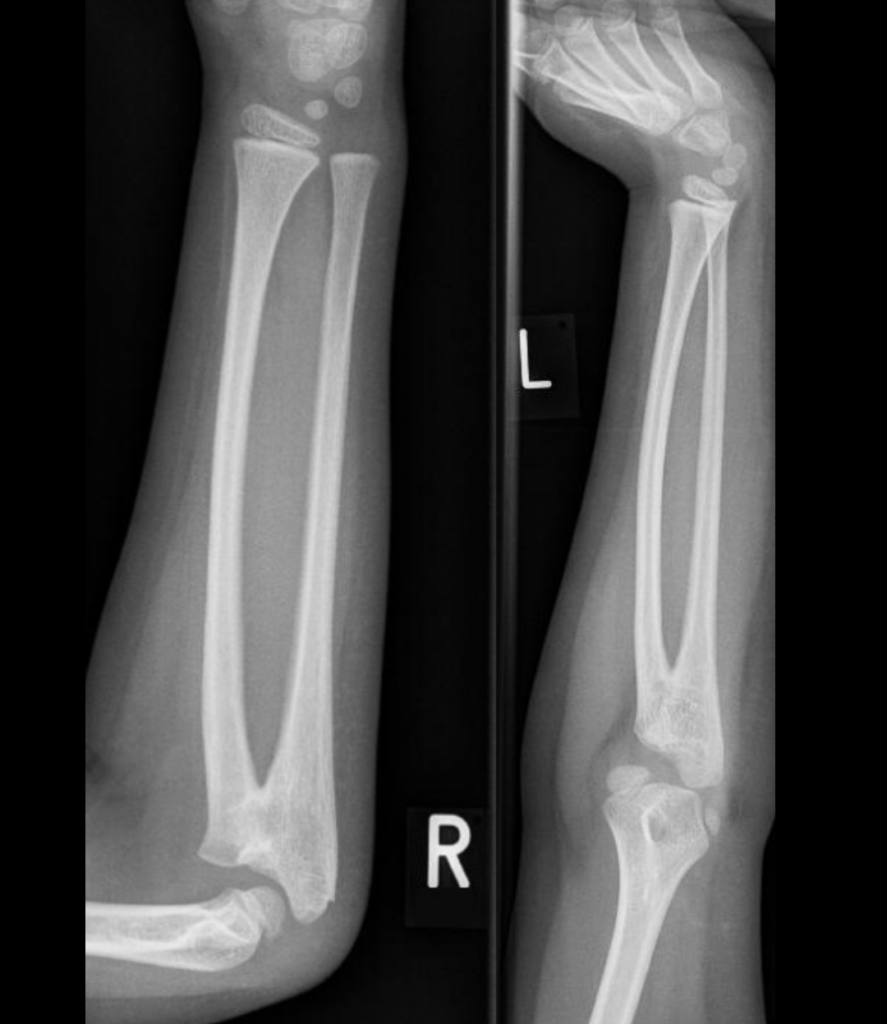
Definition
Abnormal bony connection between then radius and ulna from birth.
Anatomy
—
Epidemiology
Approximately 60% bilateral pathology
In some cases appears to be associated with autosomal dominant pattern
Even distribution between males and females (some sources state slightly more common in males 3:2)
30% of cases involved with syndromes – Klinefelter syndrome, XXXY syndrome, Apert syndrome, Crouzon syndrome, carpenter syndrome, arthrogryposis, Holt-Oram syndrome, Williams syndrome.
Aetiology
Abnormality of longitudinal segmentation
Radius and ulna initially one anlage which then divides from distal to proximal
Failure of this separation as distal to proximal segmentation occurs causing synostosis
Pathology
—-
Natural History
Congenital pathology. Does not progress.
History
Frequently unnoticed in first years of life
Pain free
Can present with issues grasping or holding items due to reduced rotational movement – carrying items, keyboard, catching balls and feeding self
Parents or caregivers (teachers, sports coaches) often first to report issue
Examination
Commonly no obvious deformity, however can have observable bony deformity if severe.
Varying amounts of flexion/extension range of motion depending on extent of synostosis
Pronation/supination range of movement most notably restricted
Forearm shortening and decreased carrying angle can be appreciated
Most common position of fixed pronation is 30 degrees
Compensatory mechanism: shoulder abduction/adduction
Wrist hyper mobility
Differential Diagnosis
—
Classification: Cleary Classification
Type 1: no osseous involvement, enlocated radial head
Type 2: osseous synostosis on xray, enlocated radial head
Type 3: visible osseous synostosis, hypoplastic and posteriorly dislocated radial head
Type 4: short osseous synostosis, anteriorly dislocated mushrooms shaped radial head
Investigation
X-ray. Further imaging rarely indicated if management is non-operative. CT can assist with extent of synostosis and 3D modelling for operative management.
Treatment
Majority of patients managed conservatively – if functional deficit does not significantly impact ability to undertake activities of daily living. This is more common in unilateral disease.
Operative:
Synostosis excision with soft tissue interposition
Forearm de-rotational osteotomy through synostosis or distal
Forearm de-rotational osteotomy with frame