
Epidemiology
- 1/2000 per annum
- Commonest long bone fracture
- Fractures of the proximal third make up 5-10% of fractures in most series
Classification
- Most surgeons use descriptive classifications
- Can use AO classification
- degree of soft tissue injury can be classified by the system of Tscherne & Gotz (1984)
| Type | Description |
|---|---|
| 0 | ~Minimal soft tissue damage resulting from an indirect mechanism of injury that has caused a simple bone fracture |
| 1 | ~Superficial abrasion or soft tissue contusion ~caused by pressure from the bone injury with a mild to moderately severe fracture pattern |
| 2 | ~Deep contaminated abrasion ~associated with localized skin & muscle contusion, an impending compartment syndrome & a high energy fracture pattern |
| 3 | ~Extensive skin contusion or crushing ~underlying severe muscle damage, a compartment syndrome & a severe fracture pattern |
Compartment syndrome
- rate of compartment syndrome varies from 1-9%
- rate of compartment syndrome is no higher when reaming is used compared with no reaming
- compartment pressure is most elevated by the use of continual traction rather than intramedullary reaming
Indications for nonoperative or operative treatment
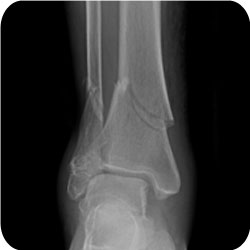
Distal Tibial & Fibular Shaft Fracture
- Published alignment parameters are guidelines at best, with no substantiated scientific data to support them
- Some accepted guidelines are:
- Varus/valgus angulation of 5-7°
- AP angulation of 10°
- Shortening of 1cm
- Rotational alignment within 10°
- There is no consensus on the best management of a closed midshaft stable tibia fracture amongst trauma experts
- In a meta-analysis by Littenberg et al (JBJSA 1998) the only strong conclusions that could be reached were that closed treatment has a lower risk of infection & open treatment has a higher rate of union
- presence of an intact fibula leads to more rapid union but is associated with an ↑ risk of angulatory deformity
Displaced tibial fractures
- 1991 RCT by Hooper reported that treatment of displaced tibial fractures by IMN resulted in a better outcome than closed treatment
- with more rapid union
- less malunion
- earlier return to work.
- Advantages & disadvantages of closed vs. open treatment
Closed treatment
- Negligible risk of infection
- Few problems with knee pain
- No need for hardware removal
Intramedullary Nailing
- Better control of alignment
- Can start early ROM of knee & ankle
- Improved mobility
- Less frequent followup
- Earlier return to work
Present indications for nonoperative management of tibial fractures
- Minimal soft tissue injuries (types 0 & 1 by Tscherne & Gotz)
- Stable fracture pattern:
- less than° coronal angulation
- less than 10° sagittal angulation
- less than 1cm of shortening
- Ability to bear weight in a cast or functional brace
Indications for nailing
- High energy fracture
- Types 2 & 3 soft tissue injuries
- Unstable fracture pattern by above definitions
- An open fracture
- Compartment syndrome
- Ipsilateral femoral fracture
- Inability to maintain reduction
- Intact fibula (relative indication)
Points on nailing
- Reaming is preferred to non-reaming.
- A larger, stiffer nail can be used which leads to less hardware breakage
- less risk of non union & repeat operations
- Proximal tibial fractures have a much higher rate of complications than midshaft fractures
- rate of nonunion is up to 84% compared with 34% in midshaft fractures
- Malunion occurs as a result of malreduction
- fracture tends to collapse into valgus
- due to loss of more lateral cortex than medial cortex
- attachment of the anterior tibial muscles on the lateral cortex acting as a tether
- fracture tends to posteriorly translate (particularly if the fracture is proximal to the bend in the nail) & flex
- fracture tends to collapse into valgus
- To avoid malreduction the entry point should be anterior & laterally
- Tornetta found the ideal entry point is 3mm lateral to the midpoint of the tibial tubercle
- Blocking (Poller) screws & unicortical plating are techniques that can be used to ↓ the risk of malunion
- Poller screws are placed posteriorly & laterally
- Flexion deformity was minimized by Tornetta by using a small medial arthrotomy with a semi-extended position
- Distal tibial fractures
- have less of a tendency to malunion than proximal fractures but are still more problematic than proximal fractures
- Technical points here
- percutaneous clamps can be used to maintain a reduction
- Plating the fibula may ↓ the rate of malunion
- A Steinmann pin placed horizontal to the joint line acts as a visual aid to reduction & can be used as a joy stick
Nailing & open fractures
- Reaming has traditionally been thought to be contraindicated in open tibial fractures because of damage to the endosteal blood supply
- Two recent RCT have shown no ↑ in the rate of infection with reaming
Complications of nailing
- Knee pain
- occurs in around 50%
- Not influenced by patellar splitting or medial parapatellar approach
- Abolished by nail removal in 50% & ↓ in 25%
- Nailing leads to ↑ patellofemoral contact forces
- Nonunion
- Bone grafting is safe after 3 months in grade 3A or 3B fractures if there is no evidence of infection
- Fibular nonunion may also occur & be a source of pain. This needs to be treated with bone grafting & compression plating
- Malunion – 12-34%
- Delayed union
- Consider prophylactic bone grafting at 6 weeks if using small diameter undreamed nail
- Rule out infection at the time of Reoperation
- Hardware failure
- This is reduced if a large reamed nail is used
- Two distal locking screws should be used – one study reported a rate of screw failure of 59% with a single screw vs. 5% with two screws
Plating
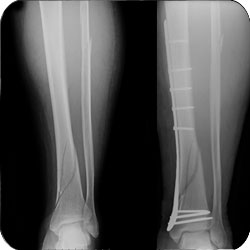
Spiral Distal Tibial & midshaft Fibular Shaft Fracture treated with Medial Locking Plate
- Plating is used mainly for metaphyseal injuries. It should not be used when there is soft tissue compromise
- plate can be placed laterally (fewer soft tissue problems & biomechanically more advantageous because acts as a tension band) or medially (preferred if subcutaneous placement)
External fixation
- External fixation may be definitive or provisional
- Provisional external fixation is the treatment of choice in injuries where there is dubious viability of the limb
- Definitive external fixation is reserved for patients with:
- very narrow intramedullary canals (less than 6mm)
- children
- patients with complex periarticular fractures
- All studies comparing Ex-fix & nonreamed nails in managing open fractures have found better results for nailing.
- rates of deformity were lower
- faster return to weight bearing
- improved limb function
- use of IMN simplified soft tissue cover & bone grafting operations
- Typically the frame is placed anteromedially
- with four pins
- two close to the fracture but not within the fracture haematoma
- other pins as far distal as possible
- connecting rods are initially placed as close to the skin as possible
- but some dynamization can be achieved by moving the rods further away from the skin
- with four pins
- Complication
- pin loosening & subsequent pin tract infection
- If the Ex-fix is to be replaced by an IMN
- pin tracts should be healed, as numerous authors have documented an ↑ rate of infection if nailing is performed after more than 2 weeks of Ex-fix
- Predrilling of all pin sites should be performed, as this may ↓ the rate of thermal necrosis
Results
| Procedure | Time to Union (weeks) | Non / delayed / Union | Malunion | Superficial Infection | Deep Infection | Reoperation |
|---|---|---|---|---|---|---|
| Closed Treatment | 17.2% 13.1% delay 4.1% non | 31.7% | 0% | 1/145 | 12/145 | |
| ORIF | 14.9 weeks | 2.6% 0.86% delay 1.7% non | 0 | 9.0% | 1/233 | 11/233 |
| Unreamed Nail | 19.5 | 16.7% 9.4% delay 7.4% non | 11.8% | 0.5% | 3/203 | 31/203 |
| Reamed Nail | 20.2 | 8.0% | 3.2% | 2.9% | 3/314 | 19/314 |